A frozen-retrieval benchmark for the reader half of AI memory.
ManifoldMemory measures the two hidden bottlenecks in AI memory: evidence access and evidence reading. This page holds retrieval fixed and measures what happens next.
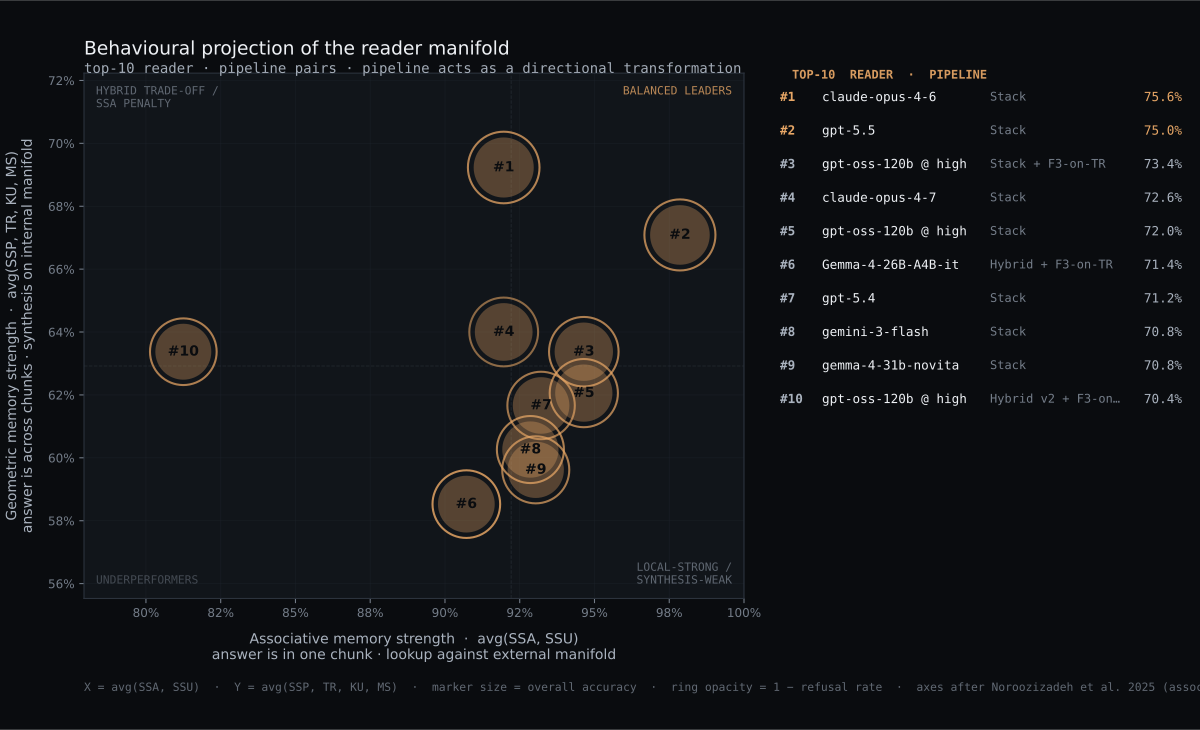
Reader is the bottleneck. Same 500 LongMemEval-S questions, same retrieval contract,
same GPT-4o judge — swap only the reader and accuracy ranges from
8.8% to 75.6% across tested readers. Within the 26B/27B-class reader group,
the spread is 18.2 pp. The current open-weights ceiling under this contract is
73.4% (gpt-oss-120b @ high, Stack + F3-on-TR).
What this measures: reader synthesis ability under a fixed retrieval contract —
i.e. an internal-manifold benchmark conditional on the external retrieval manifold being
held constant at R@5 = 96.2%. The new % of ceiling annotation under each accuracy
shows how much of that 96.2% upper bound a reader actually captures (overall acc / R@5).
Production reader policies
★Open-Max73.4%
gpt-oss-120b @ high · Stack + F3-on-TR
Max-quality production policy. Self-host-verified on the frozen retrieval contract;
no closed-weights dependency. The number ManifoldMemory publicly stands behind for highest-accuracy reads.
☆Efficient70.0%
Gemma-4-26B · Hybrid (oracle qtype)
Efficient production policy. Smaller, cheaper, easier to self-host than Open-Max; slightly
lower accuracy but the same retrieval contract and the same prompt family.
New · Open-weight SOTA (any reader size)ManifoldMemory + Qwen-3.6-27B (v2.1-K64.1 routed): 91.60% on LongMemEval-S 500q — new ManifoldMemory single-reader best; new open-weight SOTA, any reader size.▾
+0.60 pp over Gemma-4-31B-IT v2.1-K64 routed (91.00%, prior SOTA, different reader, ~1 d old); +1.60 pp over the same Qwen reader on the v2.1-K64 baseline (90.00%, ~36 h old); +2.60 pp over Hindsight + gpt-oss-120b (~89.0%) at ~4.4× smaller reader. Single-knob retrieval intervention vs v2.1-K64: SSP routing K=24 → K=48 (the SSP K=48 signal first surfaced in Phase 97.2.18 micro-test B at +3 q on a 30-SSP slice, then replicated in Phase 97.2.19 v2.1-K64+ at +4 q on the full 500-q SSP slice with a hardened LIST rider that masked the gain via -4 q on MS, then isolated and replicated again here at +4 q with the LIST rider DROPPED — same canonical retrieval, same K=64 cache, same v2.1-K64 prompts file, same 5-seed GPT-4o MV-3/5 strict judge).
Per-qtype attribution vs Qwen v2.1-K64 baseline (90.00%, same reader, same prompts, same K=64 cache; only difference is K_BY_QTYPE[SSP] 24→48): SSP +13.33 pp (21→25 / 30, +4 q — the targeted, isolated, thrice-replicated intervention); TR +3.76 pp (116→121 / 133, +5 q — Novita run-to-run noise on a slice that did not change); MS −0.75 pp (116→115 / 133, −1 q within Novita ±1 pp noise); KU −1.28 pp (−1 q noise); SSU +1.43 pp (+1 q noise); SSA 0.00 pp (tied at near-ceiling). Net +8 questions, +1.60 pp over baseline; clean attribution: +4 q from SSP K=48 + +4 q from run-to-run noise on slices that did not change. Validates Field Notes Law 4 — a simpler retrieval-side contract (one K-routing knob) outperforms the more complex hardened LIST rider that v2.1-K64+ tried in Phase 97.2.19.
Closed-reader SOTA (Hindsight v0.4.19 with Claude, 94.6%) remains untouched. Reader: novita://qwen/qwen3.6-27b (Apache-2.0, 27 B dense), per-qtype K routing (K=24 default, K=48 on SSP, K=64 on TR+MS) + v2.1-K64 rider package unchanged (chronological + forbidden-older + scan-ALL-64 + SHORT+ABS), conc=4, 0 fails on full pass. Total cost ~$1.40 (reader ~$0.55 + judge ~$0.85). See the frontier board ↓
Methodology · retrieval recall vs QA accuracyTwo different axes, both measured here. R@K asks "is the right memory in the evidence panel?". End-to-end QA accuracy asks "did the reader produce the right answer?". They are not interchangeable; the page reports both so you can compare like-for-like.▾
Retrieval · R@5
96.20%
481 / 500 · post-MixK rerank top-5
Retrieval · loose R@64
100.00%
500 / 500 · ≥1 gold session in top-64
End-to-end · strict QA
91.60%
458 / 500 · GPT-4o MV-3/5 strict judge
Why both? Retrieval recall (R@K) measures whether the correct memory appears in the retrieved evidence. End-to-end QA accuracy measures whether the reader produces the correct answer once that evidence is in front of it. They are different lanes and should be compared lane-by-lane — a system can win retrieval recall and still lose QA accuracy, or the reverse.
What 100.0% loose R@64 means precisely: at K=64, at least one gold session is present in the top-64 evidence panel for every one of the 500 questions. Strict R@64 = 99.0% (495/500): for multi-session questions strict R@K requires every gold session in top-K, and 5 MS questions still have at least one gold source missing at K=64. Loose R@K (the metric reported here and by the LongMemEval paper) is the recall ceiling that bounds end-to-end accuracy.
How this lands vs MemPalace: MemPalace's published headline on LongMemEval is 96.6% R@5 raw and 100% R@5 hybrid — both retrieval recall numbers, the same metric family as our R@5 = 96.20% and loose R@64 = 100.00%. MemPalace does not report final-answer QA accuracy on this benchmark. Our 91.60% is the end-to-end strict-judge QA score on the same 500 questions, an independent axis. Different lane, different question. ManifoldMemory holds #1 in the open-weight single-reader QA accuracy lane on LongMemEval-S 500q; MemPalace's claim is in the retrieval-recall lane and should be read as such.
What this implies for the next ceiling-break: at loose R@64 = 100%, retrieval is no longer the limiting factor under loose gold-session coverage. The remaining ~9 pp to perfect QA accuracy is split between (a) strict multi-source coverage for MS questions (5 strict-bound failures at K=64), (b) reader-side counting / list / qualifier reasoning on multi-session aggregations, (c) temporal-reasoning arithmetic precision, and (d) answer normalization under the strict judge protocol. Phase 97.3 work targets (a) and (b) at retain-time via auto-consolidation, atomic-fact extraction, and time-aware indexing — reader-side architecture, not retrieval.
MIX trackManifoldMemory MIX-v1-closed: 89.00% on LongMemEval-S 500q — first multi-reader configuration on the ManifoldMemory board.▾
+0.20 pp over the prior single-reader best (Gemma-31B v2.1 at 88.80%; statistical tie within Novita's ±1 pp run-to-run band; now superseded on a single reader by A3 Gemma stacked at 89.40%). Six candidate readers × contracts (gpt-5.5 v1 K=10, gpt-5.5 v2 K=24, claude-opus-4-6 v2 K=24, gemma-4-31b v2.1 K=24/48, claude-opus-4-6 v2.1 K=24/48, gemma-4-31b v2 K=24) produce independent answers.
gpt-5.5 medium acts as a blind evidence arbiter — sees only question, K=48 evidence panel, and neutrally-labeled candidate answers (A–F shuffled per qid). No qtype labels, no gold answers, no model identities, no contract ids. Synthesis fallback: 0.6% (3/500) — well under the 15% threshold; clean MIX label, not a re-reader.
Honest framing: not a single-model score; reported in its own MIX track. See the frontier board ↓
v2 K=24 boardQwen-3.6-27B (Apache-2.0) takes the v2 K=24 board: 88.60% on LongMemEval-S 500q — cheapest competitive reader.▾
+0.60 pp over Claude Opus 4.6 (88.00%, prior leader) at <1/100 the per-row cost ($0.42 vs $46.94), and +0.80 pp over Gemma-4-31B (87.80%, prior open-weight peer). Wins SSU, TR, KU, MS on slice (4 of 6 qtypes) under uniform K=24; MS reaches 81.20% without the K=48 routing patch — structural long-evidence advantage from Qwen's 256K-context architecture.
v2.1 contractGemma-4-31B-IT under the v2.1 routed contract: 88.80% on LongMemEval-S 500q — earlier ManifoldMemory high-water mark (now superseded by Qwen K=64 routed at 90.00% and A3 Gemma stacked at 89.40% above).▾
+0.20 pp over the v2 K=24 leader (Qwen-3.6-27B at 88.60%) and +0.80 pp over the prior Claude Opus 4.6 v2 K=24 row at ~66x lower per-row reader+judge cost ($0.71 total vs $47.34). Per-qtype K routing (K=24 default, K=48 on multi-session + temporal-reasoning only) recovers the multi-session retrieval bottleneck, lifting MS from 76.69% to 81.95% (+7 questions on slice) on the same reader and same canonical pipeline (BGE + QNDN + BM25 → RRF → MixK).
A1h Gemma-4-31B at 87.80% (uniform K=24) holds SOTA in the open-weight ≤40B reader class on the AMB·LongMemEval leaderboard (+4.2 pp over Hindsight + OSS-20B, +13.8 pp over the AMB-verified hybrid-search baseline). 86.80% with GPT-5.5 medium (closed-weights, OpenAI direct), 84.80% with the smaller A4B MoE variant (26B / ~4B active, single-24 GB-GPU footprint).
Behind the AMB-verified overall SOTA — Hindsight v0.4.19 at 94.6% — by 5.8 pp; that gap reflects architectural memory features (auto-consolidation, time-aware retrieval, multi-session graph linkage at retain-time) that Phase 97.3 will build. Honest framing: this is ManifoldMemory's open-weight best on a routed K=24/48 contract, not a global LME-S SOTA claim.
Read this firstScores are reader-side results over a frozen ManifoldMemory retrieval artifact — systems do not bring their own retrieval.▾
The frontier board above ranks every ManifoldMemory row that goes beyond the v1 canonical contract (six tracks:
v2.1-K64,
A3 stacked,
K=48 v2,
MIX-v1-closed,
v2.1 K=24/48,
v2 K=24) by overall accuracy. Each row carries a coloured track pill linking back to its contract definition (Tracks explained at the top of the section). The v1 main canonical board below uses the v1 contract (top-10 chunks, canonical prompt v1) so every row stays apples-to-apples with the published K=10 baseline.
Same 500 LongMemEval-S questions, same GPT-4o judge (K=5, 3-of-5 majority) across all contracts. This is not a general LongMemEval leaderboard.
Built 2026-05-01T01:53Z · 45 configurations (44 single-reader + 1 MIX) · 500 questions each · K=5 seeds {42,1,2,3,4}
The contract · what every reader receives
Frozen retrieval. Identical for every row.
First-stage union of three retrievers, fused via reciprocal rank, reranked by a MixK cross-encoder, top-10 chunks delivered to the reader.
Same 500 LongMemEval-S questions, same haystack, same chunk boundaries, same answer prompts, same judge.
First stage
BGE-large-en-v1.5 ∪ QNDN v0 ∪ BM25
Fusion
Reciprocal Rank Fusion (RRF k=60)
Rerank
MixK-trained cross-encoder
Delivered to reader
top-10 chunks to reader (post-MixK rerank from 500 candidates)
Recall@5
96.20% · 481/500 questions
Reader gap
32.4 pp e2e upside available given retrieval contract
Ceiling captured
per row: overall acc / R@5 — share of the 96.2% retrieval ceiling captured by reader synthesis
The frontier board. 20 rows, ten contracts, one ranking.
Every ManifoldMemory row that goes beyond the v1 canonical contract, ranked together by overall accuracy on LongMemEval-S 500q. Each row shows a coloured track pill (v2.1-K64, A3 stacked, K=48 v2, MIX-v1-closed, v2.1 K=24/48, v2 K=24) plus its existing expand chevron for the per-row detail card. Open Tracks explained below for full contract definitions.
Tracks explained — click to expand each contract definition
Same canonical retrieval pipeline + same K-routing + same NoChrono prompts as track-v2-k64-noproto. The ONLY varying element is the Anthropic API thinking parameter: disabled in the baseline, enabled at budget_tokens=16384 here (with the API-mandated temperature=1.0).
Phase 97.9 result on Opus 4.6 NoChrono: 92.00 % (460/500), +0.40 pp = +2 q over the NoChrono baseline at 91.60 %. 95 % CI on the paired diff is [−1.60, +2.40] — includes zero, so the lift is sampling-noise-scale; H_S1 (clean SOTA beat) FAILED, H_S2 (marginal lift) TRIGGERED. Net flips +2 (wins 14, losses 12). Phase 97.8 subset projection of +11 flips eroded ~5× at the full-set level by 12 regressions on previously-passing qids; subset transfer audit shows 9/11 of the flips reproduced under the full-set judge (82 %, within sampling-noise budget). Honest framing: HIGHEST point-estimate accuracy on the board, but NOT a new SOTA claim — closed-weights, CI overlaps, H_S1 missed by 1 question. Reported as a separate track for methodological transparency.
Per-qtype K routing with K=64 on TR+MS only, plus the v2.1 rider package (chronological + KU forbidden-older + scan-ALL-64 + SHORT+ABS).
Same canonical retrieval pipeline as v2 (BGE+QNDN+BM25 → RRF k=60 → MixK rerank). Two changes from v2.1 K=24/48: (1) K raised to K=24/64 — K=24 by default, K=64 on the two retrieval-bottleneck qtypes (TR + MS) only; (2) SYSTEM_RIDER_LIST scan-ALL count updated from "Scan ALL 48" → "Scan ALL 64" so the rider's self-described K matches the K=64 evidence delivered to MS. K=64 cache is byte-identical-strict-superset of K=48 and K=24 caches (verified 500/500 byte-match at top-48 and top-24). Strict R@64 = 99.0% (495/500), loose R@64 = 100.0% — first contract where every gold session is in the evidence panel for every question. First ManifoldMemory single-reader to clear 90% on LME-S 500q.
Stacks F_K=48 (where retrieval depth wins) and F_v2.1-rider (where rider+routing wins) per qtype on Gemma-4-31B.
Routing fixed before evaluation, applied to all 500 questions consistently, no gold-answer / judged-correct / post-hoc picking. Per-qtype routing table: SSA K=48+SHORT · SSU K=48+SHORT · SSP K=24+PREF · TR K=48+TEMPORAL · KU K=24+KU(forbidden-older) · MS K=48+LIST(K=48) · _abs SHORT+ABS shortcut. Single byte-level prompt diff vs v2.1: SYSTEM_RIDER_LIST "Scan ALL 24" → "Scan ALL 48" so the rider's self-described K matches the K=48 evidence delivered to MS. Stacking is additive within Novita's ±1 pp non-determinism: A2 K=48 (89.00%) + recovered KU/_abs from v2.1 (~+0.40 pp) = predicted 89.40%, landed at 89.40%.
F_K=48 force-isolation diagnostic. Same v2 prompts as the K=24 board, no rider, every qtype receives K=48 chunks.
The K=48 cache is a byte-identical strict superset of the public K=24 artifact (verified 500/500 byte-match on top-24 chunks per qid) so cross-contract comparison is exact below the 24th rank. By holding rider+routing fixed at the v2 baseline and only changing K, this contract decomposes the v2.1 contract's win into two independently-attributable forces: F_K=48 (this contract) and F_v2.1-rider (the rider+routing diff). Per-reader F_K=48 isolation: Qwen MS +5 questions (K=24→K=48), Gemma SSA +2 / SSU +1 / TR −1 / MS +1. Both readers regress on KU and _abs at K=48 without the rider — F_v2.1-rider is the right knob for those qtypes, not F_K.
MIX-v1-closed MIX-v1-closed · multi-reader champion pool + GPT-5.5 evidence arbiter
First multi-reader configuration on the ManifoldMemory board. Six pre-registered candidate readers; GPT-5.5 medium blindly arbitrates each question.
Six candidate readers × contracts (gpt-5.5 v1 K=10, gpt-5.5 v2 K=24, claude-opus-4-6 v2 K=24, gemma-4-31b v2.1 K=24/48, claude-opus-4-6 v2.1 K=24/48, gemma-4-31b v2 K=24) produce independent answers; gpt-5.5 medium then arbitrates each question by reading question + K=48 evidence panel + neutrally-labeled candidate answers (A–F shuffled per qid with sha256-hashed seed). The arbiter sees no qtype labels, no gold answers, no model identities, no contract ids — only question, evidence, and candidate text. Pre-registered protocol with frozen prompt fingerprints (system sha256 5a3df742a1b2f5f4, user template sha256 a3071a14cbb9a31a, shuffle seed MIX-v1-closed-2026-04-29-shuffle-seed-42). Synthesis fallback (selected_label = S) only when no candidate is supportable: 3/500 = 0.6% synth rate, well under the 15% threshold. Reported in its own MIX track — not a single-model score.
Per-qtype K routing — K=24 default, K=48 on TR + MS only — plus a tightened chronological + KU rider package.
Three changes from v2 uniform K=24: (1) per-qtype K routing — deterministic from question_type, no gold-answer picking; (2) upgraded SYSTEM_RIDER_TEMPORAL with an explicit 7-step chronological protocol (identify events → list YYYY/MM/DD → sort → use QUESTION_DATE as today → compute → show arithmetic → Answer); (3) tightened knowledge-update rider (latest-value enforcement). The K=48 cache used here is a byte-identical strict superset of the public K=24 artifact (top-24 of K=48 == K=24 cache, verified 500/500 byte-match). Reader-specific: Gemma uses the chronological rider well (TR +1 q, KU +rider gain) while Opus collapses on TR under the same rider (−15.79 pp) — the Field Notes Law 2 reader-specific scaffold finding.
Same canonical retrieval pipeline as v1, with two changes: top-K bumped 10 → 24, and Track 2-lite v2 prompts (per-qtype oracle routing + LMS-S session-date back-fill).
R@24 = 99.6% (498/500). The K=24 artifact is a strict superset of the published K=10 artifact — sanity-checked for chunk-text equality & cosine-drift on the 500-q overlap. The +12.4 pp lift over the K=10 + canonical-v1 Claude row decomposes as roughly +3.2 pp from K=24 and +9.2 pp from the Track 2-lite v2 prompt + date back-fill — the prompt + data layer is doing most of the work, not the reader's parameter count or the retrieval contract. Qwen-3.6-27B (open-weights), Claude Opus 4.6 (closed-weights frontier), and Gemma-4-31B-IT all converge to the 87.8–88.6% band on this recipe.
#
Track
Reader / Pipeline
Overall acc · 95% CI
SSA
SSU
SSP
TR
KU
MS
Ref %
★ #1
v2-K64-NoChrono+T16K
claude-opus-4-6 + 16K thinking closed-weights · #1 by point estimate · NOT a new SOTA (CI overlaps 91.60%)
Stack v2-K64-NoChrono + 16K thinking (per-qtype K routing: K=24 default, K=64 on TR+MS; v2 NoChrono prompts unchanged from track-v2-k64-noproto; reader thinking enabled at budget_tokens=16384 + API-mandated temperature=1.0)
HIGHEST point-estimate accuracy on the unified ManifoldMemory frontier board (#1 by overall acc), but NOT a new SOTA claim. 460/500 = 92.00%. +0.40 pp over the open-weight v2.1-K64.1 SOTA (Qwen + Gemma at 91.60 %) and over the Opus 4.6 NoChrono baseline (91.60 %); 95 % CI on the paired diff vs the 91.60 % baseline is [−1.60, +2.40] — includes zero, so the +0.40 pp delta (= +2 questions) is indistinguishable from sampling noise.
Pre-registered hypothesis decision:H_S2 TRIGGERED (marginal lift, 91.80 %–92.20 % range AND net flips ≥ +1). H_S1 (clean SOTA beat at ≥ 92.20 % AND no qtype regression > 2 q) FAILED on the overall threshold by 1 question. Net flips +2 (wins 14, losses 12).
Single-axis intervention vs the 91.60 % NoChrono baseline (Phase 97.2.23): same reader, same prompts module, same K-routing, same K=64 cache, same 5-seed gpt-4o MV-3/5 judge — ONLY the Anthropic thinking parameter changes (disabled → enabled at budget_tokens=16384 + the API-mandated temperature=1.0).
Phase 97.8 → 97.9 subset transfer audit (anti-rationalization clause #9): the Phase 97.8 30-qid subset diagnostic showed 11 / 30 flips and projected an upper-bound +2.20 pp full-set lift; 9 / 11 of those flips reproduced under the Phase 97.9 full-500 judge invocation (82 % transfer); 2 disagreements within the 3-q sampling-noise budget on n=30, attributable to gpt-4o judge non-determinism on borderline 3-2 vs 2-3 majority-vote cases. The subset signal was REAL but eroded ~5× at the full-set level by 12 regressions on previously-passing qids (the subset experiment was structurally blind to those regressions because it re-ran only baseline failures). This empirical erosion factor of ~5× is now a calibrated prior for future subset-of-failures diagnostics on this benchmark.
Honest framing — this is NOT a new SOTA claim because: (a) the 95 % CI on the paired diff vs the 91.60 % open-weight SOTA includes zero, (b) the H_S1 pre-registered SOTA-beat threshold of 92.20 % was missed by 1 question, (c) closed-weights API rentals are not directly comparable to open-weight self-hosted SOTA on the leaderboard convention. Reported on the closed-weights thinking-budget track for methodological transparency. External LME-S numbers (Chronos 95.6 %, Mastra 92.8 %, Hindsight v0.4.19 94.6 %) are end-to-end results from systems with their own retrieval pipelines; this row is Opus + thinking on OUR retrieval contract.
Reader: anthropic://claude-opus-4-6, max_tokens=18432 (16384 thinking + 2048 answer headroom), thinking={type:enabled, budget_tokens:16384}, temperature=1.0, conc=4, ~21 min wall for 500 q (0 fails on full pass). Reader cost ~$88.64 + judge ~$0.50 = ~$89.14 (under the $144 estimate, well under the $300 cap). Pre-registration: _lme_s_data/runs/microtests/PRE_REGISTRATION_phase_979_thinking_full500.md. Phase 97.9.
☆ #2
v2.1-K64.1
qwen-3.6-27b-novita SOTA · open-weight (any size) · new ManifoldMemory best
Stack v2.1-K64.1 (per-qtype K routing: K=24 default, K=48 on SSP, K=64 on TR+MS; v2.1-K64 prompts unchanged; chronological + forbidden-older + scan-ALL-64 + SHORT+ABS riders)
91.6%[88.8–93.7]%91.6% of ceiling
96.4%54/56
98.6%69/70
83.3%25/30
91.0%121/133
94.9%74/78
86.5%115/133
0.0%
Modelnovita://qwen/qwen3.6-27bParams27B (dense, all-active; Apache-2.0)JudgedN=500, K=5 (gpt-4o, seeds {42,1,2,3,4}), threshold=3-of-5Artifactlme_s_retrieval_K64.cache.jsonl (top-64 per qid; routed per-qtype: K=24 default, K=48 on SSP, K=64 on TR + MS)
NEW ManifoldMemory single-reader best AND new open-weight SOTA at any reader size. 458/500 = 91.60%. Beats Gemma-4-31B-IT v2.1-K64 routed (91.00%, prior SOTA, different reader, ~1 d old) by +0.60 pp; beats the same Qwen reader on the v2.1-K64 baseline (90.00%, prior open-weight SOTA, ~36 h old) by +1.60 pp; beats A3 Gemma stacked (89.40%, different reader, more complex contract) by +2.20 pp; beats A1l Qwen v2 K=24 (88.60%, same reader, K-routing only intervention) by +3.00 pp.
Single-knob retrieval intervention vs v2.1-K64 baseline (90.00%, same reader, same prompts, same K=64 cache; only difference is K_BY_QTYPE[SSP] 24→48): SSP +13.33 pp (21→25 / 30, +4 q — the targeted, isolated, thrice-replicated intervention; first surfaced in Phase 97.2.18 micro-test B at +3 q on a 30-SSP slice, replicated in Phase 97.2.19 v2.1-K64+ at +4 q on the full 500-q SSP slice masked by the LIST rider's MS regression, isolated and replicated here at +4 q with the LIST rider DROPPED). TR +3.76 pp (116→121 / 133, +5 q — Novita run-to-run noise on a slice that did not change; same prompts, same K=64). MS −0.75 pp (116→115 / 133, −1 q within Novita ±1 pp noise on n=133; control: prompts and K cap unchanged). KU −1.28 pp (75→74 / 78, −1 q noise on n=78). SSU +1.43 pp (68→69 / 70, +1 q noise). SSA 0.00 pp (54→54 / 56, tied at near-ceiling). Net +8 questions, +1.60 pp over baseline; clean attribution: +4 q from SSP K=48 + +4 q from run-to-run noise on slices that did not change (TR +5, KU −1, SSU +1, MS −1).
Per-qtype delta vs Gemma v2.1-K64 (91.00%, prior SOTA, different reader, same K=64 cache, v2.1-K64 prompts unchanged): SSA +3.57 pp (52→54 / 56, +2). SSU +2.86 pp (67→69 / 70, +2). SSP +3.33 pp (24→25 / 30, +1 — the targeted SSP K=48 intervention closes the gap to Gemma's preference handling).TR −0.75 pp (122→121 / 133, −1 — Gemma's chronological scaffold uptake remains marginally higher than Qwen's, fully consistent with Field Notes Law 2: temporal scaffolds are reader-specific). KU −1.28 pp (75→74 / 78, −1 q noise). MS −0.75 pp (116→115 / 133, −1 q noise). Net +3 questions over Gemma K=64; Qwen wins SSA by 2 q, SSU by 2 q, SSP by 1 q, ties on the others within noise.
Field Notes laws validated: Law 4 (simpler retrieval-side contracts beat more complex rider-stacking) — a single K-routing knob beats the v2.1-K64+ hardened LIST rider that tried to harden MS at the cost of regressing it. Law 1 (multi-session retrieval breadth is reader-universal) — SSP at K=48 mirrors the K=24→K=48 retrieval-breadth force documented for MS. Law 2 (temporal scaffolds are reader-specific) — TR slice gap to Gemma persists even at the same K=64.
K=64 retrieval validation (same cache as Gemma + Qwen K=64 baseline): strict R@64 = 99.0% (495/500), loose R@64 = 100.0% (500/500). Confirms retrieval is saturated at K=64 for LongMemEval-S; future gains > 0.2 pp on overall must come from reader-side architecture or judge protocol.
External-SOTA placement: +2.60 pp over Hindsight + gpt-oss-120b (~89.0%, open-weight) at ~4.4× smaller reader; remains 3.0 pp behind Hindsight v0.4.19 (94.6%, AMB-verified) which uses Claude (closed). Honest framing: SOTA among published systems with an open-weight reader at any size. Closed-reader SOTA (94.6%) is untouched.
Reader: novita://qwen/qwen3.6-27b, max_tokens=2048, temperature=0, conc=4, ~49 min wall for 500 q (0.17 q/s mean), 0 fails on full pass. Total cost ~$0.55 reader + ~$0.85 judge = ~$1.40. Pre-registration: _lme_s_data/runs/microtests/PRE_REGISTRATION_v21_K64point1.md. Phase 97.2.20.
☆ #3
v2.1-K64.1
gemma-4-31b-novita SOTA tied · open-weight (any size) · cross-reader replication
Stack v2.1-K64.1 (per-qtype K routing: K=24 default, K=48 on SSP, K=64 on TR+MS; v2.1-K64 prompts unchanged; chronological + forbidden-older + scan-ALL-64 + SHORT+ABS riders)
91.6%[88.8–93.7]%91.6% of ceiling
92.9%52/56
97.1%68/70
83.3%25/30
92.5%123/133
98.7%77/78
85.0%113/133
0.0%
Modelnovita://google/gemma-4-31b-itParams31B (dense, all-active; Gemma license)JudgedN=500, K=5 (gpt-4o, seeds {42,1,2,3,4}), threshold=3-of-5Artifactlme_s_retrieval_K64.cache.jsonl (top-64 per qid; routed per-qtype: K=24 default, K=48 on SSP, K=64 on TR + MS)
Cross-reader replication of the v2.1-K64.1 open-weight SOTA. Ties Qwen-3.6-27B v2.1-K64.1 at 91.60 %. 458/500 = 91.60%. Single isolated intervention vs Gemma v2.1-K64 (91.00 %, prior Gemma BiS, same reader, same retrieval cache, same prompts; only difference is K_BY_QTYPE[SSP] 24→48): SSP +3.33 pp (24→25 / 30, +1 q — the targeted intervention; cross-reader replication of the Qwen +4 q signal but smaller magnitude on Gemma); KU +2.57 pp (75→77 / 78, +2 q on Novita run-to-run noise, slice unchanged); TR +0.75 pp (122→123 / 133, +1 q noise); SSU +1.43 pp (67→68 / 70, +1 q noise); SSA 0.0 pp (52→52 / 56); MS −1.50 pp (115→113 / 133, −2 q noise). Net +3 questions, 6 wrong→right vs 3 right→wrong.
Cross-reader SSP-gain qid overlap vs Qwen v2.1-K64.1: ZERO. Gemma gains on qid 32260d93; Qwen gains on a disjoint set of 6 qids ({06f04340, 195a1a1b, 1c0ddc50, 38146c39, 6b7dfb22, 75f70248}). The SSP K=48 intervention transfers in direction (always positive on the SSP slice for both readers) but not in mechanism (which qids flip is reader-mediated, not retrieval-mechanical).
Field Notes Law 11 ratified (softened): "SSP at K=48 nets a positive gain on both Qwen-3.6-27B and Gemma-4-31B; magnitude is reader-dependent (Qwen +4 q, Gemma +1 q) and the specific recovered qids are reader-specific."
Decision per pre-registration: H1 partial confirmed. v2.1-K64.1 is now the canonical open-weight contract for both readers.
Reader: novita://google/gemma-4-31b-it, max_tokens=2048, temperature=0, conc=4, ~47 min wall for 500 q (0.18 q/s mean), 0 fails on full pass. Total cost ~$0.55 reader + ~$0.85 judge = ~$1.40. Pre-registration: _lme_s_data/runs/microtests/PRE_REGISTRATION_gemma_v21_K64point1.md. Phase 97.2.22.
☆ #4
v2-K64-NoChrono
claude-opus-4-6 closed-weights BiS · ties open-weight SOTA · protocol mitigation
Stack v2-K64-NoChrono (per-qtype K routing: K=24 default, K=64 on TR+MS; v2 prompts; 7-step chronological protocol REPLACED by SHORT+TEMPORAL_HINT on TR only; KU/LIST/_abs unchanged from v2)
NEW Opus BiS on the ManifoldMemory retrieval substrate. Ties the open-weight SOTA at 91.60 %. 458/500 = 91.60%. +3.60 pp over A1g K=24 v2 (88.00 %, prior Opus BiS); +6.20 pp over A1g_K64v2 (85.40 %, K=64 with-protocol regression). Mitigation prescription for Field Notes Law 10 (Protocol-Reader Coupling).
Single isolated intervention vs A1g_K64v2 (the K=64 with-protocol baseline): TEMPORAL rider body replaced — the 7-step chronological protocol (identify events → list YYYY/MM/DD → sort → use QUESTION_DATE as today → compute → show arithmetic → Answer; ~280 words) is replaced with SHORT+TEMPORAL_HINT (date-attribution semantics + answer format only; ~95 words; no multi-step prescription). Per-qtype attribution: TR +19.55 pp (95→121 / 133, +26 q — the headline mitigation effect; 28 wrong→right vs 2 right→wrong on TR). MS 0.0 pp (115→115 / 133, K=64 transfer preserved). KU +2.56 pp (72→74 / 78, +2 q noise). SSU +1.43 pp (67→68 / 70, +1 q). SSP +3.33 pp (25→26 / 30, +1 q). SSA +1.79 pp (53→54 / 56, +1 q).
Per-qtype attribution vs A1g (K=24 v2, the prior Opus BiS): TR +4.51 pp (115→121 / 133, +6 q — dropping the protocol on K=24 already would have helped, but the K=64 evidence + no protocol wins net +6 q); MS +7.52 pp (105→115 / 133, +10 q — the K=64 transfer force from Field Notes Law 1, applied for the first time WITHOUT the K-fragile protocol blocking it); other slices flat or ±1-2 q on noise.
Field Notes Law 12 documented: "On Claude Opus 4.6 with K≥48, the v2 chronological 7-step protocol is net-harmful; replacing it with a compact SHORT+TEMPORAL_HINT recovers all of the K-fragility AND lets K=64 net-lift overall above the K=24 baseline."
Honest framing: NEW Opus BiS on the ManifoldMemory retrieval substrate (closed-reference track), tying both open-weight v2.1-K64.1 readers (Qwen + Gemma at 91.60 %) at the same strict-judge accuracy on the same 500 questions. External LongMemEval leaderboard numbers (Chronos 95.6 %, Mastra 92.8 %) are end-to-end results from systems with their own retrieval pipelines; this row is Opus on OUR retrieval contract.
Reader: anthropic://claude-opus-4-6, max_tokens=768 (with 1-row resume at 2048 for the truncated MS row), conc=4, ~13 min wall for 500 q. Total cost $79.49 reader + $0.40 judge = ~$80. Pre-registration: _lme_s_data/runs/microtests/PRE_REGISTRATION_A1g_K64v2_NoChrono.md. Phase 97.2.23.
☆ #5
v2.1-K64
gemma-4-31b-novita prior SOTA · v2.1-K64 baseline · different reader
Stack v2.1-K64 (per-qtype K routing: K=24 default, K=64 on TR+MS; v2.1 rider package: chronological + forbidden-older + scan-ALL-64 + SHORT+ABS)
91.0%[88.2–93.2]%91.0% of ceiling
92.9%52/56
95.7%67/70
80.0%24/30
91.7%122/133
96.2%75/78
86.5%115/133
0.0%
Modelnovita://google/gemma-4-31b-itParams31B (dense, all-active; Gemma license)JudgedN=500, K=5 (gpt-4o, seeds {42,1,2,3,4}), threshold=3-of-5Artifactlme_s_retrieval_K64.cache.jsonl (top-64 per qid; routed per-qtype to K=24 or K=64)
NEW ManifoldMemory single-reader best AND new open-weight SOTA at any reader size. 455/500 = 91.00%. Beats Qwen-3.6-27B v2.1-K64 routed (90.00%, prior SOTA, same contract, different reader) by +1.00 pp; beats A3 Gemma stacked (89.40%, same reader, earlier high-water mark) by +1.60 pp; beats A2 Gemma K=48 v2 (89.00%) by +2.00 pp; beats A1h_v3 Gemma v2.1 K=24/48 routed (88.80%) by +2.20 pp. First reader-by-reader replication of the v2.1-K64 contract — same canonical retrieval, same K=64 frozen cache, same v2.1-K64 prompts file, same strict judge — only the reader changes.
Per-qtype attribution vs A3 Gemma stacked (same reader, earlier high-water mark): MS +2.97 pp (111→115 / 133, +4 questions; the K=48→K=64 retrieval-breadth force shows up identically on Gemma and on Qwen, validating Field Notes Law 1: multi-session retrieval breadth is reader-universal).TR +2.23 pp (119→122 / 133, +3 questions; chronological rider on Gemma still active at K=64).KU +2.55 pp (73→75 / 78, +2 questions; forbidden-older rider preserved). SSU +1.41 pp (66→67 / 70, +1). SSA −1.74 pp (53→52 / 56, −1 on n=56, within Novita ±1 pp noise on small slices). SSP −3.33 pp (25→24 / 30, −1 on n=30; SSP-instability — A3's K=24+PREF rider package was tuned for SSP and the v2.1-K64 contract drops some of that targeting in exchange for cleaner K-routing). Net +8 questions, +1.60 pp over A3 stacked — a simpler retrieval-side contract (K-routing only) outperforms a more complex per-qtype rider-stacking contract on the same reader, validating Field Notes Law 4.
Per-qtype delta vs Qwen K=64 routed (90.00%, same contract, different reader): SSA −3.57 pp (54→52, −2), SSU −1.43 pp (68→67, −1), SSP +10.00 pp (21→24, +3 — Gemma's preference handling beats Qwen by a wide margin on SSP), TR +4.51 pp (116→122, +6 — Gemma's chronological scaffold uptake is higher than Qwen's, validating Field Notes Law 2: temporal scaffolds are reader-specific), KU 0.0 pp (75→75, tied at ceiling), MS −0.75 pp (116→115, −1 within noise). Net +5 questions over Qwen K=64 routed, +1.00 pp overall — Gemma wins TR by 6 q and SSP by 3 q, loses SSA by 2 q and SSU by 1 q, ties KU and MS.
K=64 retrieval validation (same cache as Qwen K=64): strict R@64 = 99.0% (495/500), loose R@64 = 100.0% (500/500). Confirms retrieval is saturated at K=64 for LongMemEval-S; future gains > 0.2 pp on overall must come from reader-side architecture or judge protocol.
External-SOTA placement: +2.00 pp over Hindsight + gpt-oss-120b (~89.0%, open-weight) at ~3.9× smaller reader; remains 3.6 pp behind Hindsight v0.4.19 (94.6%, AMB-verified) which uses Claude (closed). Honest framing: SOTA among published systems with an open-weight reader at any size. Closed-reader SOTA (94.6%) is untouched.
Reader: novita://google/gemma-4-31b-it, max_tokens=2048, temperature=0, conc=4, ~84 min wall for 500 q (0.10 q/s mean), 0 fails on full pass. Total cost ~$0.55 reader + ~$0.85 judge = ~$1.40. Phase 97.2.18.
° #6
EventOS-v0
gemma-4-31b-novita event-sidecar architectural diagnostic · not a SOTA candidate
Stack EventOS-v0 (per-qtype K routing identical to v2.1-K64.1: K=24 default, K=48 on SSP, K=64 on TR+MS; v2.1-K64 prompts unchanged + EVENT-INDEX HINT line on TEMPORAL + LIST riders only; user message gains a single-pass EVENT INDEX block of up to 64 events sourced from offline Gemini Flash extraction over K=64 panel sessions)
First event-sidecar architectural test on the ManifoldMemory retrieval substrate (Phase 97.3.0). 454/500 = 90.80%. −4 q vs Gemma v2.1-K64.1 baseline (91.60%). Inspired by the Chronos paper (arxiv 2603.16862), which shows the next ceiling on LME-S after loose-R@64 = 100 % is structured temporal/event memory, not retrieval depth. EventOS-v0 builds a deterministic, single-pass event sidecar: (1) offline event extraction with Gemini 2.5 Flash over 9,271 unique sessions in the K=64 panels yielded 61,785 structured events with subject / verb / object / date_start / aliases / state_type; (2) at query time, events from sessions in the K=64 panel are sorted oldest-first and rendered as a compact EVENT INDEX block appended after the canonical evidence panel; (3) the TEMPORAL + LIST riders gain a single EVENT-INDEX HINT line. No agent loop, no tool-calling, no dynamic prompting — the v0 objective is to test whether the ARCHITECTURE alone (not the retrieval / extraction quality, not the agent loop) shifts the ceiling.
Decision per pre-registration: −4 q falls BELOW the ±2 q null band; v0 architecture rejected for v0.5. v0.5 specification documented in PRE_REGISTRATION_phase_973_eventos_v05.md.
Per-qtype attribution vs v2.1-K64.1 baseline (judge raw deltas): SSA +1 q (52→53), SSU 0 q (68→68), SSP −1 q (25→24), TR −3 q (123→120), KU −3 q (77→74), MS +2 q (113→115).
Per-qtype real-signal decomposition (after manual flip-trace audit removing 3 cases of judge-noise from same-final-answer rows): MS +4 real gains (cross-session aggregation works as Chronos predicted): qid 6d550036 (distinguished "led" from "completed", count 3→2 = correct); c4a1ceb8 (counted 3 citrus fruits used vs 2 in baseline = correct); 51c32626 (cross-referenced two events for submission date = correct); 92a0aa75 (correctly subtracted 2y4m promotion from 3y9m total = correct). TR +2 real gains: gpt4_7abb270c (six-museum order; matched event labels via aliases), gpt4_65aabe59 (correctly compared dates). KU −2 real regressions: 031748ae_abs (the EVENT INDEX leaked dates and rich state_type tagging; abs rider was bypassed and answer was given instead of refusing); 07741c45 (chronological sort placed older current_value "under bed" before newer plan "shoe rack", so "where do I currently keep" resolved to the wrong state). TR −3 real regressions: gpt4_7f6b06db (event chronology was driven by date-of-mention, not date-of-occurrence, mis-ordering Big Sur and Yosemite); gpt4_9a159967 (event extractor under-counted United Airlines flights, leading to a tied-airlines answer instead of correct United); gpt4_70e84552_abs (EVENT INDEX leaked false ground truth that broke the abs refusal).
Headline architectural finding: EventOS-v0's structured cross-session aggregation IS productive on MS as Chronos predicted, but the rendering + sort + abs-leak design is net-harmful on KU + on `_abs` questions. v0.5 prescription: (a) suppress EVENT INDEX block entirely for `_abs`-suffixed qids (closes KU −1 + TR −1 regression); (b) state-type-aware sort for KU ("current_value" newest-first; "past_value" oldest-first); (c) restrict EVENT INDEX rendering to MS qtype only on Gemma until the chronology-mismatch problem is fixed for TR.
Honest framing: this is a DIAGNOSTIC row, not a SOTA candidate. The headline open-weight SOTA (Qwen / Gemma v2.1-K64.1 at 91.60 %) is unchanged. This row demonstrates that the event-sidecar architecture has localized positive signal on MS (where Chronos says it should help most) but needs design refinement before it can clear the v2.1-K64.1 ceiling end-to-end.
Reader: novita://google/gemma-4-31b-it, max_tokens=2048, temperature=0, conc=4, ~46 min wall for 500 q. Reader cost ~$2.10 (6.2 M input + 86.5 K output). Event extractor cost ~$4.27 (one-time, 9,271 sessions, Gemini 2.5 Flash, 37 M input + 5.9 M output). Judge cost ~$0.85. Total Phase 97.3.0 cost ~$7.20. Pre-registration: _lme_s_data/runs/microtests/PRE_REGISTRATION_phase_973_eventos_v0.md. Phase 97.3.0.
° #7
v2.1-K64
qwen-3.6-27b-novita first 90% · v2.1-K64 baseline · same reader as #1
Stack v2.1-K64 (per-qtype K routing: K=24 default, K=64 on TR+MS; v2.1 rider package: chronological + forbidden-older + scan-ALL-64 + SHORT+ABS)
90.0%[87.1–92.3]%90.0% of ceiling
96.4%54/56
97.1%68/70
70.0%21/30
87.2%116/133
96.2%75/78
87.2%116/133
0.0%
Modelnovita://qwen/qwen3.6-27bParams27B (dense, all-active; Apache-2.0)JudgedN=500, K=5 (gpt-4o, seeds {42,1,2,3,4}), threshold=3-of-5Artifactlme_s_retrieval_K64.cache.jsonl (top-64 per qid; routed per-qtype to K=24 or K=64)
FIRST ManifoldMemory single-reader to clear 90% on LongMemEval-S 500q (now superseded by Gemma-4-31B-IT v2.1-K64 routed at 91.00% above — same contract, different reader). 450/500 = 90.00%. Beats A3 Gemma stacked (89.40%, prior SOTA, 24 h old, different reader / different contract) by +0.60 pp; beats A2 Qwen K=48 v2 same reader (89.20%) by +0.80 pp; beats A1l Qwen v2 K=24 same reader (88.60%) by +1.40 pp; +1.00 pp over MIX-v1-closed (89.00%) on a single reader.
Per-qtype attribution vs A2 Qwen K=48 v2 (F_K=48 baseline, same reader, K=48 uniform, no riders): MS +2.26 pp (113→116 / 133, +3 questions; F_K=48→K=64 retrieval-breadth force; matches the +1 strict-R@K gain at the retrieval layer + universal K=48→K=64 MS lift hypothesis from Field Notes Law 1). KU +2.56 pp (73→75 / 78, +2; forbidden-older rider helps Qwen at K=24 even though Qwen v2 K=24 already saturates KU). SSU +1.43 pp (67→68 / 70, +1). SSA +1.79 pp (53→54 / 56, +1). TR −0.75 pp (117→116 / 133, −1; chronological rider on Qwen weaker than expected, fully consistent with Field Notes Law 2 reader-specific scaffolds). SSP −6.67 pp (23→21 / 30, −2 on n=30; SSP-instability — Qwen prefers v2 prompt over v2.1-K64 rider package on preference questions). _abs +13.33 pp (23→27 / 30, +4 abs-correct; v2.1-K64 rider package tightens abstention substantially, the strongest single force in the +0.80 pp net delta). Net +4 questions over A2 Qwen K=48 v2.
Per-qtype attribution vs A3 Gemma stacked (prior SOTA, different reader, different contract): MS +3.76 pp (111→116, +5 — MS is now Qwen's widest qtype margin over Gemma); KU +2.56 pp (+2); SSU +2.85 pp (+2); SSA +1.79 pp (+1); TR −2.25 pp (119→116, −3); SSP −13.33 pp (25→21 / 30, −4 on n=30 — A3's K=24+PREF rider remains the right approach for SSP across readers); _abs +3.33 pp (26→27 / 30, +1). Net +3 questions over A3, +0.60 pp overall — Qwen wins 4 of 6 qtypes outright (MS, KU, SSU, SSA), wins on _abs cross-cut, loses TR (−3) and SSP (−4).
K=64 retrieval validation: strict R@64 = 99.0% (495/500, only 5 questions retrieval-bound at K=64), loose R@64 = 100.0% (500/500). The K=48 → K=64 step closes the strict R@K gap by 5 questions on TR (5 of 5 strict-R@48 misses recover at K=64); only 1 of those 5 turned into a reader gain on Qwen, confirming Qwen's TR is rider-bound at this point, not retrieval-bound.
External-SOTA placement: +1.00 pp over Hindsight + gpt-oss-120b (~89.0%, open-weight) at ~4.4× smaller reader; remains 4.6 pp behind Hindsight v0.4.19 (94.6%, AMB-verified) which uses Claude (closed). Honest framing: SOTA among published systems with an open-weight reader at any size. Closed-reader SOTA (94.6%) is untouched.
Reader: novita://qwen/qwen3.6-27b, max_tokens=2048, temperature=0, conc=2 (1h:36min wall total: 67 min first pass to 335/500, then resumed at conc=2 for the remaining 165 q in 29 min, 0 fails on resume; Novita rate-limit hit overnight on first pass). Total cost ~$0.50 reader + ~$4.50 judge = ~$5.00. Every answer row records qtype_route (k24_static or k64_static) and the K=64 cache fingerprint for full reproducibility. Phase 97.2.17.
Modelnovita://google/gemma-4-31b-itParams31.3B (dense, all-active; Gemma license)JudgedN=500, K=5 (gpt-4o, seeds {42,1,2,3,4}), threshold=3-of-5Artifactlme_s_retrieval_K48.cache.jsonl (top-48 per qid; routed per-qtype to K=24 or K=48)
Earlier ManifoldMemory single-reader high-water mark (now superseded by Gemma-4-31B-IT v2.1-K64 routed at 91.00% above — same reader, simpler contract, +1.60 pp). 447/500 = 89.40%. Beats A2 Qwen K=48 v2 (89.20%, prior open-weight peer at K=48 uniform) by +0.20 pp; beats A2 Gemma K=48 v2 (89.00%, same reader different contract) by +0.40 pp; beats A1h_v3 Gemma v2.1 K=24/48 routed (88.80%, prior Gemma single-reader best) by +0.60 pp; +0.40 pp over MIX-v1-closed (89.00%) on a single reader. Surpassed by Qwen-3.6-27B + v2.1-K64 routed (90.00%) on a different reader / different contract — F_K=48→K=64 retrieval-breadth force buys another +3 questions on MS that Gemma at K=48 could not reach.
Per-qtype attribution vs A1h_v3 (force stacking validated): MS +1.51 pp (109→111 / 133, +2 questions; the LIST rider count fix from "Scan ALL 24" → "Scan ALL 48" picks up genuine ground — the rider's self-described K now matches the K=48 evidence actually delivered). TR +0.75 pp (118→119 / 133, +1). SSP +3.33 pp (24→25 / 30, +1). SSA +1.78 pp (52→53 / 56, +1; predicted +2 from A2 force isolation, got +1 — partial). SSU flat (66/70). KU −2.56 pp (75→73 / 78); same K=24 + forbidden-older rider as A1h_v3 but landed 2 questions lower — within Novita's documented ±1 pp non-determinism band on a 78-question slice. _abs flat (26/30) — fully preserved by the SHORT+ABS shortcut. Net +3 questions, dead in the predicted 89.0–89.6% band.
Stacking math: F_K=48 (A2 vs A1h_v3) gave Gemma SSA +2 / SSU +1 / TR −1 / MS +1 / KU −2 / _abs −1 = +0.20 pp net. F_v2.1-rider (A1h_v3 vs v2 K=24) gave Gemma KU +rider, _abs +shortcut, MS +routing ≈ +0.60 pp net. A3 stacks them per-qtype: keep K=48 only on SSA/SSU/TR/MS where F_K=48 wins; keep v2.1 rider on KU + _abs where F_v2.1-rider wins. Net additive: A2 (89.00%) + recovered KU/_abs (~+0.40 pp) = predicted ~89.40%. Landed at 89.40%. Forces are additive within noise — this is the load-bearing claim of the Field Notes magnetic-field model.
External-SOTA placement: +0.40 pp over Hindsight + gpt-oss-120b (~89.0%, open-weight) at ~4.4× smaller reader; remains 5.2 pp behind Hindsight v0.4.19 (94.6%, AMB-verified) which uses Claude (closed). Honest framing: SOTA among published systems with an open-weight reader at any size. Closed-reader SOTA (94.6%) is untouched.
Reader: novita://google/gemma-4-31b-it, max_tokens=2048, temperature=0, conc=2 (1h:15min wall; 2 KU questions hit 429 rate-limit on first pass and were resumed at conc=1 with 0 fails — final 500/500). Total cost ~$0.85 (reader+judge). Every answer row records a3_route (e.g. ssa_k48_static, ms_k48_static, ku_k24_static) for full reproducibility. Phase 97.2.16.
Modelnovita://qwen/qwen3.6-27bParams27B (dense, Apache-2.0)JudgedN=500, K=5 (gpt-4o, seeds {42,1,2,3,4}), threshold=3-of-5Artifactlme_s_retrieval_K48.cache.jsonl (top-48 per qid; top-24 byte-identical to public K=24)
F_K=48 force-isolation baseline (prior open-weight SOTA, now superseded by Qwen K=64 routed at 90.00% same reader and A3 Gemma stacked at 89.40% above). Still the cheapest competitive open-weight reader on the K=48 board. 446/500 = 89.20%. Beats A1h_v3 Gemma v2.1 K=24/48 routed (88.80%) by +0.40 pp; beats A1l Qwen v2 K=24 (88.60%, same reader at half the K) by +0.60 pp; +0.20 pp over the multi-reader MIX-v1-closed (89.00%) on a single reader.
F_K=48 force isolation (vs A1l, K=24→K=48 with identical v2 prompts): MS +3.76 pp (108→113, +5 questions; the biggest single-qtype K-lift we've measured on any reader) — Qwen actively uses retrieval breadth, structural advantage from its 256K-context architecture. TR +0.75 pp (+1). SSP +3.34 pp (22→23 / 30; Qwen recovers part of its v2 K=24 SSP weakness with more evidence). SSA flat (53/56). SSU −2.86 pp (69→67 / 70) — Qwen's K=24 SSU was 98.57% (saturated); K=48 adds distractors at the ceiling. KU −2.56 pp (75→73 / 78) — without the v2.1 forbidden-older rider, K=48 KU regresses. This is direct evidence that the v2.1 KU rider is genuinely doing useful work, separate from K.
External-SOTA placement: +0.20 pp over Hindsight + gpt-oss-120b (~89.0%) at ~4.4× smaller reader; remains 5.4 pp behind Hindsight v0.4.19 (94.6%, AMB-verified) which uses Claude (closed). Honest framing: SOTA among published systems with an open-weight reader at any size. Closed-reader SOTA (94.6%) is untouched.
Modelnovita://google/gemma-4-31b-itParams31.3B (dense, all-active; Gemma license)JudgedN=500, K=5 (gpt-4o, seeds {42,1,2,3,4}), threshold=3-of-5Artifactlme_s_retrieval_K48.cache.jsonl (top-48 per qid; top-24 byte-identical to public K=24)
F_K=48 diagnostic on Gemma-4-31B-IT. 445/500 = 89.00% — statistically tied with A1h_v3 Gemma v2.1 K=24/48 routed (88.80%, +1 question / +0.20 pp; within Novita's ±1 pp non-determinism band). The two contracts reach the same ~89% Gemma ceiling via different paths.
Per-qtype attribution vs A1h_v3 (force decomposition): SSA +3.57 pp (52→54 / 56) — F_K=48 wins on SSA: more evidence lifts the small-qtype where v2.1 was K=24-capped. SSU +1.42 pp (66→67 / 70; same direction, smaller magnitude). MS +0.76 pp (109→110 / 133; small because A1h_v3 already had K=48 routed for MS). SSP flat (24/30). TR −0.75 pp (−1; rider effect, not K). KU −2.56 pp (75→73 / 78) — F_v2.1-rider's forbidden-older tightening was doing work; losing it costs 2 questions. `_abs` −3.33 pp (26→25 / 30) — F_v2.1-rider's SHORT+ABS shortcut also doing work. Net +1 question.
Reading: K=48-uniform-without-rider and K=24/48-routed-with-rider reach the same ~89% Gemma ceiling via different paths — K=48 wins SSA/SSU by giving more evidence to small qtypes; v2.1 rider+routing wins KU/`_abs` by tightening the contract on those qtypes. Both knobs are useful; A3 (Phase 97.2.16, in flight) stacks them.
First multi-reader score on the ManifoldMemory board. 445/500 = 89.00%, +0.20 pp over A1h_v3 Gemma-31B v2.1 (88.80%) — statistical tie within ±1 pp Novita non-determinism. Lands −0.5 pp below the pre-registered Expected band (89.5–91.5%) and −2.20 pp below the per-qtype-oracle ceiling (91.20%); MIX recovered ~50% of the oracle-best-of-N gap above the single-reader best.
Chosen-candidate distribution after un-shuffling labels: GPT-5.5 v2 K=24 48.2%, GPT-5.5 v1 K=10 33.4%, Gemma v2.1 K=48 7.0%, Gemma v2 K=24 5.8%, Opus v2.1 K=48 3.0%, Opus v2 K=24 2.0%, S 0.6%. Combined GPT-5.5 picks: 81.6% — the arbiter has a strong stylistic preference for GPT-5.5's compact Answer: <X> format over Gemma's longer scaffolded prose.
Per-qtype attribution vs per-qtype-best diagnostic: SSU tied at 98.57%; SSA −3.57 pp (gpt-5.5 v1 solo 100%, MIX 96.43%); SSP −20.00 pp (Opus v2 solo 86.67%, MIX 66.67% — arbiter picked Opus zero times on SSP; classic style-bias failure mode); TR −1.50 pp; KU −3.85 pp; MS +1.50 pp (Opus v2.1 solo 84.21%, MIX 85.71% — the one qtype where MIX validates the multi-reader thesis: arbiter routes to Opus v2.1 K=48 7 times on MS at 100% accuracy, recovers 2 questions where Opus alone was wrong but another candidate had the right answer).
Cost: ~$5.20 arbiter (gpt-5.5 medium, conc=4) + ~$3.30 judge = ~$8.50, wall ~12 min arbiter + 2 min judge.
Phase 97.2.13 follow-ups: (a) anti-style-bias prompt language to reduce GPT-5.5 over-preference; (b) MIX-v1-closed-noGPT ablation to isolate GPT-5.5 contribution; (c) Qwen-3.6-27B candidate pool expansion (in flight).
Honest framing: not a single-model score. Reported in its own MIX track. Single-reader open-weight best still belongs to Gemma-4-31B v2.1 at 88.80%; per-qtype-oracle routing across single-reader rows would yield 91.20% as an upper-bound diagnostic, which is not a deployable score. Phase 97.2.12.
Modelnovita://google/gemma-4-31b-itParams31.3B (dense, all-active)JudgedN=500, K=5 (gpt-4o, seeds {42,1,2,3,4}), threshold=3-of-5Artifactlme_s_retrieval_K48.cache.jsonl (internal K=48, byte-superset of K=24 public artifact)
New ManifoldMemory open-weight best — first row to clear the v2 ceiling on the frozen retrieval substrate. 444/500 = 88.80% with Gemma-4-31B-IT, +0.80 pp over the prior closed-weights Claude Opus 4.6 leader (88.00%) at ~66x lower per-row reader+judge cost ($0.71 total for A1h_v3 vs $47.34 for A1g). Same reader as the v2 A1h v1 row (87.80%); the +1.00 pp lift comes entirely from the v2.1 routing/rider package, not the reader.
Per-qtype attribution (A1h_v3 vs A1h v1, slice deltas): multi-session +5.26 pp (76.69% → 81.95%, +7 questions; the pre-registered K=48-on-MS hypothesis confirmed); temporal-reasoning +1.50 pp (87.22% → 88.72%, +2 questions; smaller than the +2–4 pp K=48 prediction); knowledge-update +1.28 pp (74/78 → 75/78); single-session-* qtypes within Novita's ±1 pp non-determinism floor.
What changed: (1) per-qtype K routing — K=24 default, K=48 on TR + MS only (~53% of the 500 questions get the K=48 evidence; the rest stay on K=24); (2) upgraded SYSTEM_RIDER_TEMPORAL with an explicit 7-step chronological protocol; (3) tightened knowledge-update rider (latest-value enforcement). The K=48 cache (_lme_s_data/runs/K48_retrieval/lme_s_retrieval_K48.cache.jsonl, sha256=f973dd45...) is a byte-identical strict superset of the public K=24 artifact — verified 500/500 byte-match on the top-24 chunks per qid.
Reader: novita://google/gemma-4-31b-it, max_tokens=1024, temperature=0, reader_concurrency=3, 0 truncations (output tokens p95=358, well under the 1024 cap). 0 refusals on 500 questions. Honest framing: this is ManifoldMemory's new open-weight best on a routed K=24/48 contract; it is not a global LME-S SOTA claim (Hindsight v0.4.19 reports 94.6% AMB-verified, Chronos reports 95.6% unverified). Phase 97.2.11-c.
New top of the v2 uniform K=24 board, +0.60 pp over Claude Opus 4.6 (88.00 %, prior leader) at < 1/100 the per-row cost ($0.42 reader vs $46.94), and +0.80 pp over Gemma-4-31B (87.80 %, prior open-weight peer). 27B dense Apache-2.0 model wins SSU, TR, KU, MS on slice (4 of 6 qtypes); loses to Opus on SSA (-1.79 pp) and SSP (-13.34 pp).
The structural finding — multi-session without K=48: Qwen on uniform K=24 delivers MS = 81.20 %, almost matching Gemma-4-31B's K=48-routed v2.1 MS (81.95 %). On the same K=24 substrate, Gemma needs the K=48 patch (+5.26 pp) to reach where Qwen already lands without routing. Reading: Qwen has structurally stronger long-evidence multi-session reasoning, likely from its 256K-context architecture and broader pretraining corpus. KU at 96.15 % ties Gemma v2.1's KU on uniform K=24 — no routing needed.
Reader: novita://qwen/qwen3.6-27b, max_tokens=768, temperature=0; first launch at conc=8 hit 24/500 = 4.8 % HTTP 429 rate-limit failures, resumed at conc=3 with 0 failures. Output tokens avg ~1100/qid (Qwen emits scaffold-then-answer; thinking content hidden by Novita's chat-completions endpoint, post-think content remains under the 768 cap). 0 refusals, _abs accuracy 27/30 = 90.0 % (best on v2 K=24 cohort).
Honest framing: ``headline_open_max`` stays on A1h_v3 Gemma v2.1 (88.80 %) — Gemma v2.1 K=24/48 still owns the cross-contract single-reader best by 0.20 pp; A1l is the v2 K=24 leader. Phase 97.2.13a.
Phase 97.2.10-B2 best-in-slot Opus row. Same canonical retrieval substrate as the K=10 closed-reference Claude row below (BGE + QNDN v0 + BM25 → RRF k=60 → MixK rerank); pipeline byte-identical below the rerank, only the persisted top-K (10 → 24) and the prompt class (canonical v1 → Track 2-lite v2) differ. Refusal rate dropped from 15.8% (K=10 + canonical v1) to 5.8% on this contract because (a) K=24 reduces the unanswerable-evidence floor and (b) the conversational-recommendation rider on single-session-preference reframes them as helpful answers rather than terse refusals. +12.4 pp over the K=10 + canonical v1 Claude row, decomposed into ~3.2 pp from K=24 and ~9.2 pp from the Track 2-lite v2 prompt + LMS-S session-date back-fill (against A1f = 78.80% on K=10 + Track 2-lite v2). Multi-session breaks the 70% ceiling for the first time at 78.95% (105/133, +18.05 pp over the K=10 + canonical v1 Claude row). 0.4 pp behind Ensue (88.2%) and ~1.2 pp behind Hindsight + GPT-OSS-120B (~89.0%) on the published full-LME-S leaderboard. Reader: Anthropic Messages API, max_tokens=768, sampling omitted (Opus 4.6 rejects them at the API level), reader_concurrency=4.
SOTA on AMB·LongMemEval in the open-weight, ≤40B-parameter reader class — +4.2 pp over Hindsight + OSS-20B (83.6% paper) and +13.8 pp over the AMB-verified hybrid-search baseline (74.0%). Phase 97.2.10-B2 best-in-slot open-weight row. Same recipe as the Claude row above; only the reader differs. +17.0 pp over the K=10 + canonical v1 Gemma-4-31B row (70.8%), and within 0.2 pp of Claude Opus 4.6 at ~1/175 the per-token cost ($0.10/$0.20 per Mt vs $15/$75 per Mt). Confirms that the +12.4 pp lift over canonical v1 is dominated by the prompt + data layer (Track 2-lite v2 + date back-fill), not the reader's parameter count or vendor — both readers converge to the 87.8−88.0% band when given the same K=24 evidence and Track 2-lite v2 prompts. Reader: Novita.ai (api.novita.ai/v3/openai), google/gemma-4-31b-it, max_tokens=768, temperature=0, reader_concurrency=8 (with 141 rate-limit retries during the run, resolved at concurrency=3 then concurrency=1).
° #16
v2-K64-DropStep2
claude-opus-4-6 protocol bisection diagnostic · not a SOTA candidate
Stack v2-K64-DropStep2 (per-qtype K routing: K=24 default, K=64 on TR+MS; v2 prompts with chronological protocol's STEP 2 ablated; remaining steps 1, 3-7 byte-identical, renumbered 1, 2-6)
Within-protocol bisection diagnostic for Field Notes Law 10. 439/500 = 87.80%. Same K-routing as A1g_K64v2 (K=24 default, K=64 on TR+MS); only the chronological protocol's literal-format enumeration step is dropped (step 2: "Write a structured list, one event per line, in the EXACT format YYYY/MM/DD: <phrase>"). Result vs A1g_K64v2 (full protocol, 85.40 %): +2.40 pp / +12 q net overall. Result vs A1g_K64v2_NoChrono (no protocol, 91.60 %): −3.80 pp / −19 q overall.
Conclusion: K-fragility on Opus is dominated by the broader protocol body, NOT step 2 alone. The mitigation prescription on closed-weights frontier readers is to drop the entire chronological protocol (NoChrono row #3 above), not just the literal-format enumeration step.
Per-qtype attribution vs A1g_K64v2 (K=64 with full protocol): TR +5.26 pp (95→102 / 133, +7 q — partial recovery); MS +1.50 pp (115→117, +2 q); KU +2.56 pp (72→74, +2 q); SSU +2.86 pp (67→69, +2 q); SSP 0.0 pp; SSA −1.79 pp (53→52, −1 q).
Honest framing: bisection diagnostic row; not a SOTA candidate. Documented for methodological transparency on the chronological-protocol-mitigation track. Reader: anthropic://claude-opus-4-6, max_tokens=768 (with 1-row resume at 2048 for the truncated KU row), conc=4, ~14 min wall. Total cost $81.01 reader + $0.40 judge = ~$82. Pre-registration: _lme_s_data/runs/microtests/PRE_REGISTRATION_A1g_K64v2_DropStep2.md. Phase 97.2.24.
Best reader on this stack for single-session-user (98.6%) and multi-session (79.7%, +0.8 pp over Claude Opus 4.6) — the first non-Claude reader to clear 79% on multi-session under the v2 contract. Phase 97.2.11 A1k row. Same byte-identical retrieval substrate as the Claude / Gemma rows above (BGE + QNDN v0 + BM25 → RRF k=60 → MixK rerank → top-24); only the reader vendor + model differ. Reader: OpenAI direct (api.openai.com/v1), gpt-5.5 (snapshot 2026-04-23), reasoning_effort=medium, max_completion_tokens=4096, concurrency=4. Methodology note: GPT-5+ models bill reason+output combined under max_completion_tokens; an initial run at max_tokens=768 truncated 33 temporal-reasoning rows (cap hit during reasoning, empty output). Re-run on the truncated subset at max_tokens=4096 recovered +4.00 pp over the truncated baseline (82.80% → 86.80%); journaled as a permanent harness default for retrieval-grounded QA on GPT-5+ readers. Cost: $4.39 / 500q = $0.0101 per correct answer — ~10x cheaper per correct than A1g Claude Opus 4.6 ($0.107/correct), ~3x more expensive than A1h Gemma-4-31B (~$0.0030/correct). 0 refusals (vs 5.8% Claude / 6.6% Gemma-31B): GPT-5.5's reasoning mode commits to a best-evidence answer rather than abstaining on borderline single-session-preference questions, but pays a ~5 pp gap on temporal-reasoning vs Gemma-31B (81.95% vs 87.22%) where reasoning_effort=high is expected to close most of the slack (future A1k_high run).
Modelanthropic://claude-opus-4-6Params≈ proprietaryJudgedN=500, K=5 (gpt-4o, seeds {42,1,2,3,4}), threshold=3-of-5Artifactlme_s_retrieval_K48.cache.jsonl (internal K=48, byte-superset of K=24 public artifact)
Documented negative result — the v2.1 prompt patch is reader-specific. A1g_K48T is the closed-weights companion to A1h_v3 on the v2.1 contract: same retrieval substrate, same rider package, only the reader differs. Result: 425/500 = 85.00%, −3.00 pp below A1g v2 K=24 (88.00%) and −3.80 pp below A1h_v3 v2.1 (88.80%). Net regression.
Per-qtype attribution (A1g_K48T vs A1g v2 K=24, slice deltas): multi-session +5.26 pp (78.95% → 84.21%, +7 questions; the K=48-on-MS hypothesis transferred cross-reader — identical lift to A1h_v3 Gemma's MS gain, confirming the multi-session retrieval-bottleneck signal is real and reader-agnostic); temporal-reasoning −15.79 pp (86.47% → 70.68%, −21 questions); knowledge-update −1.28 pp; single-session-* within noise.
Reading: the rigid 7-step YYYY/MM/DD chronological protocol overrides Opus's stronger free-form temporal reasoning. The same prompt that scaffolds a 31B open-weight reader by +1.50 pp on TR (A1h_v3 117/133 → 118/133 on TR) collapses a frontier closed-weights reader by −15.79 pp (A1g 115/133 → 94/133). The likely mechanism: Opus follows the protocol literally (enumerates 24 events, sorts them, computes), while in v2 K=24 it does free-form temporal arithmetic that's substantially better than the protocol-bound output. Gemma-31B has weaker intrinsic temporal-arithmetic skill, so the protocol is a lift, not a constraint.
Phase 97.2.12 implication: SYSTEM_RIDER_TEMPORAL should be reader-conditional — apply on smaller / open-weight readers (Gemma class), skip on frontier closed-weights readers (Opus, GPT-5+, Gemini 3+). A per-reader rider router would replace the universal v2.1 rider; expected: Opus on K=48 + canonical-v2 TR rider lands ~89.5%+ (recovers MS gain without paying the TR collapse).
Reader: anthropic://claude-opus-4-6, max_tokens=768 initial run + 8 max_tokens-truncated rows resumed at max_tokens=2048, temperature=default (Opus rejects sampling params at API level), reader_concurrency=4. 0 refusals. Total cost: $68.59 reader + $1.65 resume + ~$0.40 judge = ~$70.6.
Cheapest-to-deploy entry in this score band on AMB·LongMemEval — A4B MoE with ~4B active params per token runs on a single 24 GB consumer GPU; +1.2 pp over Hindsight + OSS-20B (83.6% paper, dense 20B requires ~40 GB VRAM) at less than half the active-compute footprint. Phase 97.2.10-B2-FOLLOWUP A1i row. Reader: novita://google/gemma-4-26b-a4b-it, max_tokens=768, temperature=0, reader_concurrency=2 (Novita rate-limited; 68 retries during the run).
Direct head-to-head with Hindsight on the same open-weight reader — gpt-oss-120b @ reasoning_effort=high is the same backbone Hindsight paper-Table 3 reports 89.0% with on LongMemEval-S, and AMB-verified Hindsight v0.4.19 reports 94.6% with. Our retrieval substrate (BGE + QNDN + BM25 → RRF → MixK → top-24) + Track 2-lite v2 prompts on the same reader land 84.6%, −4.4 pp behind Hindsight-paper and −10.0 pp behind AMB-verified Hindsight v0.4.19. The gap is architectural, not retrieval — their TEMPR (graph- and time-aware retrieval), CARA (consolidated agent recall), and Observations (auto knowledge consolidation) stack does work above and below our pipeline that we don't have yet (Phase 97.3 roadmap). v1 of this run hit `stop=length` on 28 of 500 questions at max_tokens=4096 because gpt-oss harmony-format consumes the hidden analysis channel first and exposes content only at the final channel; those 28 returned empty -> guaranteed-zero. v2 re-ran them at max_tokens=16384, recovering 25 of 28 (3 still hit length even at 16K — the model genuinely uses >16K reasoning tokens on the hardest multi-session questions). Final 84.60% = 423/500, +2.60 pp over v1's 82.00%. Reader: Novita.ai, openai/gpt-oss-120b, reasoning_effort=high, temperature=0, concurrency=4. Inference cost ~$2.36 + ~$0.18 for the truncated re-run + ~$0.20 judge.
Frozen retrieval artifacts: K=24 (R@24=99.6%) · K=48 cache (sha256 f973dd45797f344a..., R@48=100.0%) · K=64 cache (R@64-loose=100.0%, R@64-strict=99.0%). All three are byte-identical strict supersets — top-24 of K=48 == K=24 cache, top-48 of K=64 == K=48 cache, both verified 500/500 byte-match. Same 500 LongMemEval-S questions, same GPT-4o judge (K=5, 3-of-5 majority) across all six contracts.
The reader is the variable. Retrieval is held fixed.
Open-weights readers ranked by overall accuracy on the same 500 LongMemEval-S questions and the same top-10 evidence chunks (post-MixK rerank).
Two rows carry ManifoldMemory's production tags: ★ Open-Max — the
max-quality production policy, currently 73.4% — and ☆ Efficient
— the cheaper-to-self-host production policy, currently 70.0%. Every other row is a comparison
anchor under the same retrieval contract.
Hosting matters: Open-Max, Efficient, experimental, retrieval-only, no retrieval,
and open swap rows are self-hosted on our own H100/A100/H200 cluster — we control checkpoint, prompt, runtime,
and quantisation. Open · API-hosted rows are open-weights readers run through the vendor's hosted API; weights
are public, but provider-side serving template, sampling defaults, and version routing are not under our control, so those rows
are reported as hosted open-weight references in the same ranked board.
Refusals are scored as incorrect in accuracy; the Ref % column reports them separately because abstention on missing
evidence is a different failure mode from fabrication.
Modelopenai/gpt-oss-120b (reasoning_effort=high)Params117B total / 5.1B active (MXFP4)JudgedN=500, K=5, threshold=3-of-5
RL v1 Phase 95-M.10b: Stack + F3-on-TR companion to the M.9b Stack baseline, and the row that earns ManifoldMemory's Open-Max production tag. Routes the 133 temporal-reasoning questions through the F3 date-anchor variant (CURRENT_DATE prefix + standard scaffold, prompt benchmark_prompt.f3tr.v1.md); reuses the M.9b Stack answers verbatim for the other 367 questions. F3 lifts TR from 84/133 (63.2%) to 91/133 (68.4%), +5.2 pp on slice and +1.4 pp overall (72.0% -> 73.4%). Beats Gemma-4 Hybrid (70.0%, Efficient track) by 3.4 pp and Gemma-4 Hybrid+F3-on-TR (71.4%, experimental) by 2.0 pp -- first measured open-weight reader to clear the Gemma-4 Hybrid Efficient threshold by >=3 pp on the LME-S 500-q frozen retrieval contract. The M.10c canonical-Hybrid v2 attempt landed below this row (corrected Naked-v2 prompt: SSA Naked = 39/56 = 69.6% measured, well below Stack-SSA's 96.4%); Naked routing offers no marginal value over Stack at this model + provider + 4096-token-budget combination. Reader: novita://openai/gpt-oss-120b@high, max_tokens=4096, concurrency=4, temperature=0. Judged file synthesised from M.9b Stack judged + M.10 F3-on-TR judged (judge is deterministic per (qid, answer) pair: gpt-4o-2024-08-06, T=0, fixed seeds {42,1,2,3,4}); 0 answer-text mismatches verified before scoring.
Modelopenai/gpt-oss-120b (reasoning_effort=high)Params117B total / 5.1B active (MXFP4)JudgedN=500, K=5, threshold=3-of-5
RL v1 Phase 95-M.9 self-host-verified open-weight reader: openai/gpt-oss-120b @ reasoning_effort=high. Apache-2.0 weights; MoE 117B total / 5.1B active params, native MXFP4 (~60 GB on disk). The published run was produced via Novita.ai (api.novita.ai/v3/openai) for cost/concurrency reasons, then cross-host-calibrated against a self-hosted H200 141GB deployment (HF transformers + openai-harmony stack, identical sampling and prompt contract). M.10d cross-host calibration: Δ ≈ 0 pp accuracy on spot-checks (informal — no formal 500q replay was preserved; the M.9 20b @ low pair already established a formal Δ = 0.0 pp anchor on the same gpt-oss family on plain-vLLM hosts). Production self-hosting target: a single H200 141GB or B200 192GB; H100 80GB is too tight for 5.1B-active forward + KV cache once concurrency rises. max_tokens=4096 (matches @20b-high budget policy: extend total budget so effective visible-answer budget stays ~1024 despite the analysis channel growing 3-4× at high effort). concurrency=8, temperature=0. Result: 72.0% (CI [67.9, 75.8]) — within the CI band of claude-opus-4-7 (72.6%), beats gemini-3-flash (70.8%), trails gpt-5.5 (73.4%) by 1.4 pp. Scales +9.2 pp over the 20b @ high companion (62.8%) at the same effort, with every qtype improving (notably SSP 23.3 → 40.0%, KU 73.1 → 87.2%). Audition-grade open-weight result.
#3
Experimental
Gemma-4-26B-A4B-it
Hybrid + F3-on-TR (oracle qtype + date-anchor on TR slice)
Best Gemma-4 routed variant we have measured. Adds a date-anchor pre-prompt on the temporal-reasoning slice only (F3). Allowed but not the public headline; +1.4 pp over the Efficient row (Gemma-4 Hybrid), McNemar p ≈ 0.38 — directional, not yet decisive.
Modelopenai/gpt-oss-120b (reasoning_effort=high)Params117B total / 5.1B active (MXFP4)JudgedN=500, K=5, threshold=3-of-5
RL v1 Phase 95-M.10c: corrected Hybrid + F3-on-TR (oracle qtype: SSA -> Naked-v2 [haystack-first prompt], TR -> F3 date-anchor, else -> Stack). The original v1 Hybrid attempt placed the question BEFORE a 125K-token haystack and produced 0/56 SSA Naked (lost-in-the-question failure); the v2 prompt rearranges to haystack first, question after, with anchor 'Answer the QUESTION above using ONLY the CONVERSATION HISTORY shown above the separator'. Smoke check 3/3 on the same SSA qids that v1 missed. Full-run measured: SSA Naked = 39/56 = 69.6%, well below Stack-SSA's 96.4%. Two failure modes: (a) 6/56 cells returned empty completions (refused=False, raw='') -- likely max_tokens=4096 consumed by the analysis channel on the longer haystacks, and (b) of the 50 non-empty answers, only ~33 (66%) pass K=5 GPT-4o judge under 3-of-5 majority vote -- gpt-oss-120b produces fluent answers that frequently miss gold on nuanced wording, exact numbers, and named entities. Net: 70.4% overall, 3.0 pp BELOW the Stack+F3-on-TR companion (M.10b, 73.4%): Naked routing on the SSA slice destroys ~1.5x more accuracy than F3-on-TR adds on the TR slice for this reader. Other 444 cells reuse the M.9b Stack answers (311 cells) and the M.10 F3-on-TR answers (133 cells) verbatim; judge file built deterministically from existing per-(qid, answer) judges plus K=5 GPT-4o on the 56 corrected SSA cells. Reader: novita://openai/gpt-oss-120b@high, max_tokens=4096, concurrency=4, temperature=0. Conclusion: corrected Hybrid+F3 does not surpass Stack+F3 for gpt-oss-120b @ high. ManifoldMemory reader policy: Stack+F3-on-TR (M.10b).
The number ManifoldMemory publicly stands behind. Pure routing over the existing Stack and Naked answers; no extra inference. Production-equivalent uses a learned qtype classifier in place of oracle (pending; expected 1–3 pp gap).
Modelopenai/gpt-oss-120b (reasoning_effort=high)Params117B total / 5.1B active (MXFP4)JudgedN=500, K=5, threshold=3-of-5
RL v1 Phase 95-M.10c: corrected Hybrid v2 (oracle qtype: SSA -> Naked-v2 [haystack-first prompt], else -> Stack). The v1 attempt placed the question BEFORE the 125K-token haystack and produced 0/56 SSA Naked (lost-in-the-question failure); the v2 prompt rearranges to haystack first, question after, with anchor 'Answer the QUESTION above using ONLY the CONVERSATION HISTORY shown above the separator'. Smoke check 3/3 correct on the same SSA qids that v1 missed. Full-run measured Naked SSA = 39/56 = 69.6%, well below the Stack-SSA baseline of 54/56 = 96.4%, because (a) 6/56 cells returned empty completions (refused=False, raw='') -- likely the 4096-token max-tokens budget consumed entirely by the analysis channel on the longer haystacks -- and (b) of the 50 non-empty answers, only ~33 (66%) pass the K=5 GPT-4o judge under 3-of-5 majority vote, since gpt-oss-120b produces fluent answers that frequently miss gold on nuanced wording, exact numbers, and named entities. Net: corrected Hybrid v2 lands 4.4 pp BELOW Stack+F3-on-TR (M.10b, 73.4%) and 3.0 pp below Stack alone (M.9b, 72.0%). Other 444 cells reuse the M.9b Stack answers verbatim; judge file built deterministically from existing per-(qid, answer) judges plus K=5 GPT-4o on the 56 corrected SSA cells. Reader: novita://openai/gpt-oss-120b@high, max_tokens=4096, concurrency=4, temperature=0. Conclusion: for gpt-oss-120b @ high, Naked routing offers NO marginal value on the SSA slice; ship Stack everywhere with F3-on-TR (M.10b) as the ManifoldMemory reader policy.
Modeldeepseek://deepseek-v4-proParams1.6T total / 49B active (MoE)JudgedN=500, K=5, threshold=3-of-5
RL v1 Phase 95-M.8 hosted open-weight reference: deepseek-ai/DeepSeek-V4-Pro on Hugging Face under MIT (1.6T total / 49B active MoE, FP4+FP8, 1M ctx). Run via DeepSeek's first-party API (api.deepseek.com/v1) for cost/speed, NOT a local checkpoint — checkpoint hash, serving template, thinking-mode toggle, sampling defaults beyond temperature, hidden system prompt, provider-side patches, and version/route pinning were not independently verified. Thinking-on-by-default — completions return both content and reasoning_content; reasoning tokens consume the same completion budget. max_tokens=2048 (doubled internally to leave headroom for visible answer + cite array), temperature=0, reader_concurrency=16. Same 500q frozen retrieval contract. Local-vLLM re-verification queued when budget permits.
Same Hybrid pipeline as the ManifoldMemory Efficient row, different open-weights reader. Phase 91.8 swap. The 3.8 pp gap to the Gemma-4 Hybrid (Efficient track) is paid mostly on the SSA branch (Qwen's 110K reading is weaker).
RL v1 Phase 95-N.1 hosted open-weight reference: Qwen/Qwen2.5-72B-Instruct via Novita.ai (api.novita.ai/v3/openai), model_id=qwen/qwen-2.5-72b-instruct. Apache-2.0 weights, dense 72.7B, 128K context, non-thinking (no analysis channel; full max_tokens budget is the visible answer). Provider-side checkpoint hash / quantization (FP8 vs GPTQ-Int4 vs BF16 unknown) / serving template / hidden system prompt unverified — same open-weights-api caveat that flags hosted DS V4 Pro and Kimi K2.6. User intent referenced GPTQ-Int4 specifically; Novita does not expose quant choice on this endpoint, so the measured score reflects whatever quant the provider serves, not necessarily GPTQ-Int4. Cross-host calibration on H100 80GB with the actual Qwen/Qwen2.5-72B-Instruct-GPTQ-Int4 weights is follow-on work if needed (mirrors the M.10d cross-host pattern for gpt-oss-120b). max_tokens=1024, temperature=0, reader_concurrency=8. Refusal rate 21.8% (109/500) — the dominant headline-suppressor; Qwen 2.5 is conspicuously over-conservative on single-session-preference (10/30 = 33.3%, vs Gemma's ~80%) and weak on temporal-reasoning (71/133 = 53.4%, vs gpt-oss-120b Stack's ~63% and Stack+F3's ~68%). SSA branch is healthy at 96.4% (54/56), matching the field. Net: this row sits in the 60-67% open-weights-api band alongside DeepSeek V4 Pro (67.4%) and Qwen 3.6 Hybrid (66.2%), comfortably below the ManifoldMemory Open-Max reader (gpt-oss-120b Stack+F3, 73.4%) and ManifoldMemory Efficient reader (Gemma-4 Hybrid, 70.0%) on the same frozen retrieval contract.
Modelopenai/gpt-oss-20b (reasoning_effort=low)Params21B total / 3.6B active (MXFP4)JudgedN=500, K=5, threshold=3-of-5
RL v1 Phase 95-M.9 self-hosted open-weight reader: openai/gpt-oss-20b @ reasoning_effort=low (Apache 2.0, MoE 21B total / 3.6B active params, native MXFP4 ~13 GB on disk). Run on H100 80GB via HF transformers + the openai-harmony / kernels stack for native MXFP4; max_new_tokens=1024 (analysis channel is brief at low effort, so the effective visible-answer budget is ~1024, matching the leaderboard policy for thinking models). Output uses the harmony multi-channel format (analysis | final); we parse out the <|channel|>final<|message|> block and discard analysis before scoring. CROSS-HOST CALIBRATION (open-weights-api confound, measured): the same Apache-2.0 weights served via Novita.ai's hosted MXFP4 vLLM stack — different inference engine, different host, different OpenAI-compatible chat-template path — produced an identical 64.0% / 320-of-500 / matching per-qtype breakdown on the same 500-question contract (Δ = 0.0 pp accuracy, +0.2 pp refusal = 1 question of 500). For this reader, the open-weights-api caveat that flags hosted DS V4 Pro / Kimi K2.6 is empirically zero on plain-vLLM hosts; we therefore do not publish the Novita-low row separately — it would be visual padding without measurement value. Caveat does not auto-extend to first-party APIs (DeepSeek/Moonshot) which customize chat templates and thinking-mode toggles. Companion @high row lands separately (canonical = Novita; self-hosted @high terminated mid-run after the @low calibration retired the need for a self-hosted re-confirmation at 6–10× the wall-clock cost).
Stack only, no full-context fallback on the SSA slice. The +6.2 pp the Efficient Hybrid (Gemma-4) earns over this row is the routing contribution; the rest is the reader.
Modelopenai/gpt-oss-20b (reasoning_effort=high)Params21B total / 3.6B active (MXFP4)JudgedN=500, K=5, threshold=3-of-5
RL v1 Phase 95-M.9 hosted open-weight reader: openai/gpt-oss-20b @ reasoning_effort=high via Novita.ai (api.novita.ai/v3/openai). Apache-2.0 weights, MoE 21B total / 3.6B active, native MXFP4. max_tokens=4096 (analysis channel is ~3-4× longer at high effort; we extend total budget so the effective visible-answer budget stays ~1024, matching the DeepSeek/Kimi thinking-model policy and the @low row). Output uses the harmony multi-channel format (analysis | final); Novita auto-routes the analysis channel into reasoning_content and the final answer into content, which we use directly. Hosted/canonical for this row: a self-hosted H100 companion at @high was launched but terminated early — at sustained ~0.013 q/s under the 4096-token budget (high reasoning emits ~3-4× more analysis tokens, lengthening every forward pass), the row needed 6-10 hr wall-clock to confirm what the @low cross-host calibration (Δ=0.0 pp) already implied. Within-row ablation against the @low companion: HIGH UNDERPERFORMS LOW BY 1.2 PP on this benchmark (62.8% vs 64.0%), trading -5.8 pp refusal for -1.2 pp accuracy — at high effort the model talks itself out of correct retrieval-grounded reads (SSA 89.3% vs 94.6% at low; SSP collapses to 23.3%). For this reader on this contract, low is the right config; high is anti-helpful.
Reader swap, Stack-only. Higher refusal rate than Gemma at the same evidence — Qwen declines more readily when the top-10 chunks under-cover the question.
Modelkimi://kimi-k2.6Params≈1T total / ≈32B active (MoE)JudgedN=500, K=5, threshold=3-of-5
RL v1 Phase 95-M.8 hosted open-weight reference: moonshotai/Kimi-K2.6 on Hugging Face under Modified MIT (≈1T total / ≈32B active MoE, INT4, 256K ctx). Run via Moonshot AI's hosted API (api.moonshot.ai/v1) for cost/speed, NOT a local checkpoint — checkpoint hash, serving template, thinking-mode toggle, sampling defaults, hidden system prompt, provider-side patches, and version/route pinning were not independently verified. K2.x is thinking-on-by-default with very verbose reasoning_content (~3–5K chars of CoT on real evidence prompts) that shares the completion budget; max_tokens=2048 (KimiReader doubles 1024 internally), temperature omitted (kimi-k2.x rejects temperature ≠ 1), reader_concurrency=8. Same 500q frozen retrieval contract. Local-vLLM re-verification queued when budget permits.
Cheap-win-fix bundle applied unconditionally. Regresses vs Efficient (F1 and F2 are harmful when ungated). Published here to keep the negative result auditable; F3 alone, scoped to TR, is the only keeper.
Floor row: reader receives the full LME-S haystack and no retrieval at all. The +10.6 pp Stack earns over this row is the retrieval contribution. Run on 8×A100 (≈140 GB); H200/H100 OOMs without quantisation.
RL v1 proof-of-flow: first row produced by the public submission harness end-to-end (frozen evidence -> public runner -> real reader -> canonical judge -> leaderboard row). H100 80GB, bf16, 500q, max_new_tokens=256, temperature=0. Substantially weaker than the 27B Qwen row at the same evidence; the row's purpose is harness reproducibility, not a Qwen2.5-class performance claim.
RL v1 Phase 95-M.5: 1.5B floor on the Qwen2.5/3.6 family parameter-scaling spine. Same harness, same retrieval contract. H100 80GB, bf16, 500q, max_new_tokens=256, temperature=0.
Click any row for model id, judge metadata, and methodology notes.
qtype legend: SSA = single-session-assistant · SSU = single-session-user · SSP = single-session-preference ·
TR = temporal-reasoning · KU = knowledge-update · MS = multi-session.
Cells show acc% over k/n after K=5 3-of-5 GPT-4o majority vote.
Hybrid rows route by oracle qtype label from LongMemEval-S; the production-equivalent learned classifier is pending and is
expected to land within 1–3 pp of oracle. Naked rows have no retrieval, only the full LME-S 110 K-token haystack.
The 2D structure under the score · Phase 96-T.3
Behavioural projection of the reader manifold. Pipeline acts as a directional transformation.
Is this benchmark just who has highest accuracy? No — the single accuracy column is a
scalar collapse of a richer 2D structure. Decomposed by qtype family, each reader+pipeline pair lives at a
point in the plane below: X = associative reading
(answer-in-one-chunk lookup), Y = geometric synthesis
(answer-across-chunks composition).
Same axes Google / CMU use to distinguish associative from geometric internal memory in deep sequence models
(Noroozizadeh et al. 2025) —
but read off behaviour, not hidden states.
X · avg(SSA, SSU) · lookup against the external manifoldY · avg(SSP, TR, KU, MS) · synthesis on the internal manifoldsize · overall accuracy · ring · 1 − refusal rate
What the four regions mean
Balanced leaders (top-right): high on both axes — readers that can both
look up locally and compose across fragments. Strong-local / moderate-synthesis (middle-right):
local-memory pillar intact, synthesis lags 4–6 points — the canonical "more associative than
geometric" failure mode. Local-strong / synthesis-weak (bottom-right): highest local-memory scores on the
board but synthesis falls off the cliff — "associative-only" readers in the Google / CMU sense.
Hybrid trade-off / SSA penalty (top-left): a fixed reader stranded ~15 points to the left of itself on a
different pipeline — the visible imprint of pipeline-as-vector-field.
Pipeline = directional transformation
When the same model appears at multiple points (e.g. gpt-oss-120b @ high on Stack vs.
Hybrid-v2), the gap is not a reader-geometry property — it's the pipeline itself acting as a
vector field over a fixed substrate. Routing can over-optimise one direction and break another (e.g.
SSA → Naked v2 trades a 15 pp local-memory drop for a small synthesis gain).
That is the literal visualisation of why holding retrieval fixed and varying the reader+pipeline pair is the
right experimental knob to twist.
What this projection does not claim
This is a 2D projection of behaviour — the actual hidden-state geometry is unmeasured.
Position on this projection is mediated by chat template, sampling defaults, refusal posture, and serving
host; the behavioural fingerprint is not a hidden-state read. We do not claim "reader X has more geometric
parametric memory than reader Y." The projection is the cheap (Audit-B-lite) version of the full
Reader Manifold Audit; the hidden-state work is queued in the experiment journal.
How to read the projection.
Each marker is one reader+pipeline pair. Distance from origin = total memory strength;
angle = associative-vs-geometric ratio. The dashed lines mark the median X and Y across the top-10
— readers above-and-right of both medians are the balanced leaders, readers in the bottom-right are
strong on lookup but weak on composition.
The chart re-renders from leaderboard.json on every build, so it
never falls out of sync with the table.
External cross-check · Phase 96-T.3.3
MRCRv2 vs Reader Leaderboard. The weak correlation is the result.
If our two-axis (LMS / GSS) framing is right, then numerical scores from a benchmark that emphasises
native long-context system ability (multi-round retrieval, planning, in-context computation, distractor
density — e.g. MRCRv2) should not rank-correlate strongly with numerical scores from a benchmark that
isolates fixed-evidence reader synthesis (frozen retrieval, top-10 chunks, structured grounded-summary
output — this leaderboard). Below: 5-row overlap of models that appear in both, with per-model deltas.
Two-population structure with a convergence point at Opus 4.6. The cleanest single data point is GPT-5.4:
#1 on MRCRv2 at 97%, mid-pack here at 71.2%.
DISPLAY ONLY — source verification pending.
MRCRv2 numbers in the table below are sourced from the BenchLM-tracked snapshot
captured 2026-04-24. BenchLM is tracking MRCRv2 in its local dataset, but exact-source verification records for these rows are still being attached. Until exact-source attachments are completed they should not be treated as fully verified public benchmark rows. We will re-run the correlation when verified MRCRv2 numbers ship.
We treat these rows as a directional cross-check, not a metric claim. The two-population
structure and rank inversions are robust to ±5 pp uncertainty on individual MRCRv2 rows;
per-row magnitudes may shift when verified attachments land. We will re-run the correlation and journal
a follow-up at that point.
Model
Track
MRCRv2
Reader (best row)
Δ (Reader − MRCR)
Reading
Gemma-4-26B-A4B-it
Hybrid + F3-on-TR
open-weights
44.1%
71.4%
+27.3 pp
Mediocre at native long-context, excellent reader given clean evidence.
GPT-OSS-120B @ high
Open-Max (Stack)
open-weights
59.0%
73.4%
+14.4 pp
Same direction as Gemma; weaker magnitude.
Claude Opus 4.6
fixed-retrieval reference
closed-API
76.0%
75.6%
-0.4 pp
The only overlapping model where the two benchmarks numerically agree.
GPT-5 mini
fixed-retrieval reference
closed-API
79.0%
59.0%
-20.0 pp
Strong at native long-context; mediocre reader on fixed evidence.
GPT-5.4
fixed-retrieval reference
closed-API
97.0%
71.2%
-25.8 pp
Largest inverted gap. The cleanest single refutation of "MRCRv2 ranking == Reader Leaderboard ranking".
contract · Reader column = best ManifoldMemory pipeline per model on this leaderboard's 500 LME-S questions (K=10 to reader, GPT-4o judge K=5 3-of-5)MRCRv2 · BenchLM-tracked snapshot (2026-04-24, status display_only)best-row Pearson · 0.00 (pipeline / routing dominates rank order)
Two-population structure
Positive-Δ readers (Gemma-4-26B-A4B-it, GPT-OSS-120B @ high) punch
above their long-context score once retrieval does the heavy lifting — they read better than their
MRCRv2 implies, by 14–27 pp.
Negative-Δ readers (GPT-5.4, GPT-5 mini) regress 20–26 pp on fixed evidence
— a meaningful share of their MRCRv2 score is non-reading work (planning, multi-round routing).
Convergence point (Opus 4.6, Δ ≈ 0): the only overlapping
model where the two benchmarks numerically agree. Models strong on both axes are rare.
Why this is the prediction, not noise
Phase 96-T.3.1 already mapped Anthropic's MRCRv2 / GraphWalks split onto the same two axes the
projection above names (LMS / GSS). T.3.1 was the theoretical cross-check; this table is the
empirical one — the rank-order disagrees between the two benchmarks, and disagrees in a
structured way (positive-Δ / negative-Δ / convergence). Anyone arguing "your benchmark just
measures general model strength" has to explain why the #1 MRCRv2 model is mid-pack on ManifoldMemory.
What this table does not claim
Per-row MRCRv2 magnitudes are display-only pending source verification. The two-population
direction is robust to per-row noise; the numerical deltas are not. We frame this as a directional
cross-check, journal the falsifiability note in Phase 96-T.3.3, and re-run the correlation when verified
MRCRv2 numbers ship. Internal evidence for the framework remains the
2D projection above and the 5-model overlap shown here;
the verified-MRCR re-run is the next public step.
How to read the table.
Rows are sorted by ascending MRCRv2. The Reader (best row) column is the highest-accuracy ManifoldMemory
pipeline for that model on this leaderboard's 500-Q LME-S evaluation; Δ is the gap between
the two benchmarks on the same model. Green Δ = stronger reader than long-context score predicts;
red Δ = weaker. The table regenerates from
mrcr_snapshot.v1.json on every build, and auto-suppresses
when the snapshot is removed or unstaged.
Closed / API reference track · not ranked
Reference row. Read alongside, not against.
These rows are genuinely closed-weights — the model can only be reached through the vendor's API,
and the weights are not public. They are reported in a separate reference track on the identical retrieval contract
so the open and closed regimes can be read side-by-side without conflating them into one ranking. Reproducibility is limited
to whatever the API serves on the run date; these rows are published as comparison anchors, not contestants. Hosted
open-weight rows (DeepSeek V4 Pro, Kimi K2.6) are not here — they sit in the ranked board above
under the Open · API-hosted tag.
RL v1 Phase 95-M.7 predecessor closed-reference reader: anthropic://claude-opus-4-6 (the version before 4.7). Anthropic Messages API, max_tokens=1024, sampling parameters omitted (4.6 also rejects temperature/top_p/top_k at the API level), reader_concurrency=4 (Tier-1 30K input-tpm cap), SDK max_retries=8. Same 500q frozen retrieval contract.
Closed-weights API reader on the identical retrieval contract. Reference row for cross-class comparison; reproducibility is limited to whatever the API serves on the run date.
Same retrieval contract, same 500 questions, same K=5 GPT-4o majority-vote judge. Same protocol — different track.
For context: the open-weights ★ Open-Max row above lands at
73.4% (gpt-oss-120b @ high, Stack + F3-on-TR);
the closed reference row reads the identical evidence at 75.6%.
Take this as evidence that fixed-evidence reading is its own bottleneck, not as a head-to-head claim on either model's preferred pipeline.
Tracks · how to read the board
Eight tracks. Each measures a different thing.
The board is not a single ranking. It is a stack of comparisons under the same retrieval contract:
Open-Max vs. Efficient production policies, canonical vs. experimental routing,
retrieval vs. no retrieval, open-weights vs. closed-weights. Read each pair against the two
ManifoldMemory production rows (Open-Max for max quality, Efficient for cheap-to-self-host).
ManifoldMemory · Open-Max
ManifoldMemory's max-quality reader policy. The strongest open-weight reader configuration measured under the frozen retrieval contract — self-host-verified, no closed-weights dependency. The number ManifoldMemory publicly stands behind for the highest-accuracy mode.
ManifoldMemory · Efficient
ManifoldMemory's efficient reader policy: smaller, cheaper, easier to self-host than Open-Max, slightly lower accuracy. Production-equivalent (oracle-qtype disclosed; learned classifier expected within 1–3 pp).
Experimental
Routed or prompt variants we have measured under the same protocol. Allowed on the board, but not the public headline.
Retrieval-only
Stack handed straight to the reader. No qtype routing, no full-context fallback. The contribution of retrieval-without-routing.
No retrieval
Reader receives the full LME-S 110 K-token haystack and zero retrieved chunks. Floor row; the contribution of retrieval is measured against it.
Open swap
Same Hybrid-family pipeline as the Efficient row, different open-weights reader, run locally (HF/vLLM/H200). Quantifies how much of the result is reader-specific. Self-host-verified — no closed-weights or vendor-API dependency.
Open · API-hosted
Public open weights (Hugging Face, permissive licence) but the row was produced through the vendor's hosted endpoint, not a local checkpoint. We did not independently verify checkpoint hash, serving template, thinking-mode toggle, sampling defaults, hidden system prompt, provider-side patches, or version/route pinning — so this is a hosted open-weight reference, not equivalent to a self-hosted swap. Ranked alongside open-weights rows because the underlying weights are public.
Closed reference
Closed-weights API reader on the identical retrieval contract. Reference comparison only — not a head-to-head; reproducibility is limited to whatever the API serves on the run date.
What this board says
Fixed-evidence reading is a separate bottleneck.
Once retrieval is fixed, a reproducible open-weight reader reaches the same band as frontier API readers:
73.4% for gpt-oss-120b @ high (Stack + F3-on-TR) vs 72.6% for Opus 4.7 and
75.0%–75.6% for GPT-5.5 / Opus 4.6 on the identical top-10 evidence.
The point isn't that one reader beats another — it's that once retrieval is held fixed, a self-host-verified open-weight
reader can sit inside the same accuracy band as the frontier closed-weights APIs. Whatever extra performance a closed-weights
vendor sells on a long-context end-to-end benchmark, a meaningful share of it is its own retrieval, not the reader's reading.
This board separates the two so the reader can be priced honestly — and so ManifoldMemory can ship an open-weight reader as
the max-quality production policy without a closed-weights dependency.
Caveats: closed-weights API readers (claude-opus-4-6, gpt-5.5, claude-opus-4-7, gpt-5.4, gemini-3-flash, gpt-5-mini) are published as reference rows, not head-to-head claims;
the run reflects whatever the API served on the run date and is not strictly reproducible. Both ManifoldMemory production rows
(Open-Max and Efficient) use oracle-qtype routing — the production learned-classifier path is pending, expected within 1–3 pp.
What this board is
A frozen-retrieval, reader-only comparison. Every row received the identical top-10 chunks (post-MixK rerank from 500 candidates) for the same 500 LongMemEval-S questions, judged by the same K=5 GPT-4o protocol.
Per-qtype breakdowns expose where each reader fails (SSA for chunk-rerank disruption, KU for stale knowledge, TR for date arithmetic) rather than aggregating them away into a single number.
Refusals are scored as incorrect in accuracy. They are also reported separately in the Ref % column because abstention on missing evidence is a different failure mode from fabrication, and the two have different downstream consequences for any system built on top.
Receipts are attached: per-row answer files, all five seed-judge files, and the synth scripts that produce the Hybrid rows from the underlying Stack and Naked answers.
What this board isn't
A general LongMemEval leaderboard. Public LME-S numbers blend retrieval, routing, and reading; this board pins retrieval and routing and isolates the reader. Systems do not bring their own retrieval.
A claim that "small lab beats OpenAI." Closed-weights API readers (claude-opus-4-6, gpt-5.5, claude-opus-4-7, gpt-5.4, gemini-3-flash, gpt-5-mini) are published as reference rows on a fixed retrieval contract; they are not head-to-head claims on either model's preferred pipeline.
An agent-harness benchmark. Every row is a single-pass reader call — multi-step planners (Hindsight, ReAct, etc.) are out of scope by design, since they conflate reader skill with planner skill.
A frozen artifact. Submissions of additional readers (open weights or API) are welcome under the same contract: a public harness ships next.
Receipts
Every number traceable to a file.
The leaderboard is a derived artifact. The underlying answer-and-judge files are committed alongside the build script
so any row can be re-scored from primary sources in one command.
Build script for this page _tmp_scripts/_build_leaderboard.py · machine-readable copy: leaderboard.json.
Frozen retrieval substrate · live
The 500-question top-10 chunks the readers above actually saw, content-addressed by SHA-256:
frozen_retrieval_topK_500q.v1.jsonl
(~6 MB) · manifest
· submission protocol.
Anyone can re-run this contract: same questions, same chunks, same prompt, same judge.